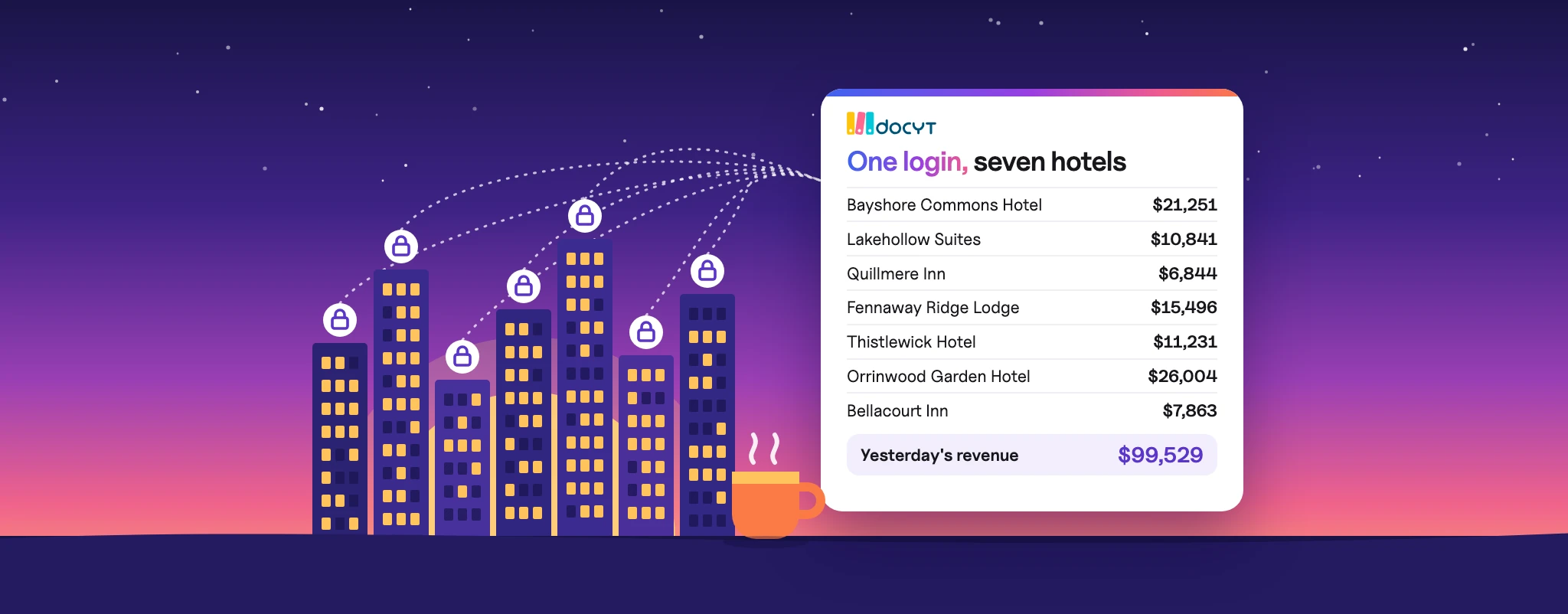
One hotel operator we spoke with recently described the start of every workday. Before anything else, she logs into seven different property management systems and brand platforms, one for each flag in the portfolio. Each one asks for its own password and its own multifactor code. Only after all seven can she piece together how the hotels performed yesterday.
If you manage a multi-brand portfolio, that routine probably sounds familiar. Multi-brand hotel revenue reporting has a way of growing one login at a time, until checking yesterday’s numbers becomes a morning project. The cost is bigger than it looks, and most of it never shows up on a P&L.
Why multi-brand portfolios end up with so many logins
Nobody designs a reporting process around seven portals. It happens gradually:
- Franchise requirements. Many brands require their own PMS or brand platform, so each new flag adds a system.
- Acquisitions. Every hotel you buy arrives with the tools the previous owner chose.
- Separate data for separate questions. Daily revenue lives in one place, brand programs in another and accounting in a third.
Each decision makes sense on its own. Together, they turn a simple question, “How did we do yesterday?”, into a daily scavenger hunt.
The real cost of multi-brand revenue reporting
1. Hours that add up quietly
Consider a simple illustration. If logging in, finding the right report and copying the numbers takes about five minutes per platform, seven platforms cost 35 minutes a day. Over roughly 250 workdays, that is about 145 hours a year, nearly a month of full-time work, spent collecting numbers rather than acting on them. Your figures may be higher or lower, but the pattern holds for most multi-brand teams.
2. Numbers that don’t line up
Different systems often define, label and time their reports differently. One may cut off the business day at a different hour, another may group revenue in different buckets. When those reports land side by side in a spreadsheet, a property can look stronger or weaker simply because of how its system reports. A shared standard like the Uniform System of Accounts for the Lodging Industry (USALI), whose 12th Revised Edition has an adoption date of January 1, 2026, gives you consistent definitions, but only if every property’s data is mapped to it.
3. Spreadsheet errors
Every manual copy and paste is a chance for a transposed digit or a row pasted into the wrong column. With seven sources a day, small errors are almost guaranteed over time, and they tend to surface at the worst moment, in front of an owner or lender.
4. Security and access risk
More portals mean more credentials to manage. Under time pressure, teams sometimes share logins or route every multifactor code to one person’s phone. That undermines the protection multifactor authentication is meant to provide. CISA’s guidance on multifactor authentication explains why a second credential matters: if a password is compromised, an attacker still can’t get in without it. Shared access also makes offboarding harder, because every portal a departing employee touched has to be updated.
5. Decisions made later than they should be
When assembling the numbers takes most of the morning, problems surface later in the day, or not until the weekly review. A dip in occupancy at one property or an unusual rate at another is easier to fix on Tuesday than the following Monday.
What good multi-brand revenue reporting looks like
The goal isn’t to replace every brand system. Franchise platforms still have jobs to do. The goal is to stop using them as your daily reporting tool. Strong hotel portfolio reporting has a few things in common:
- One source of truth built from each property’s night audit, not from screenshots of seven dashboards.
- Consistent definitions for occupancy, ADR, RevPAR and revenue categories across every brand.
- Portfolio and property views so leadership sees the whole picture and can drill into any hotel.
- Context built in, with each day compared to budget and the same period last year.
- Role-based access so owners, regional leaders and GMs each see what they need through one login.
Five steps to consolidate your hotel portfolio reporting
- Inventory every login. List each portal, who uses it, what they pull from it and how often. You will likely find overlap and reports nobody reads.
- Agree on standard KPIs. Write down how your organization defines each metric and which revenue categories roll into it, ideally aligned to USALI.
- Make the night audit your source of truth. Daily revenue should flow from each property’s night audit into one place, mapped consistently. We walk through how that posting should work, and where it typically breaks, in our guide to night audit to general ledger posting across a hotel portfolio.
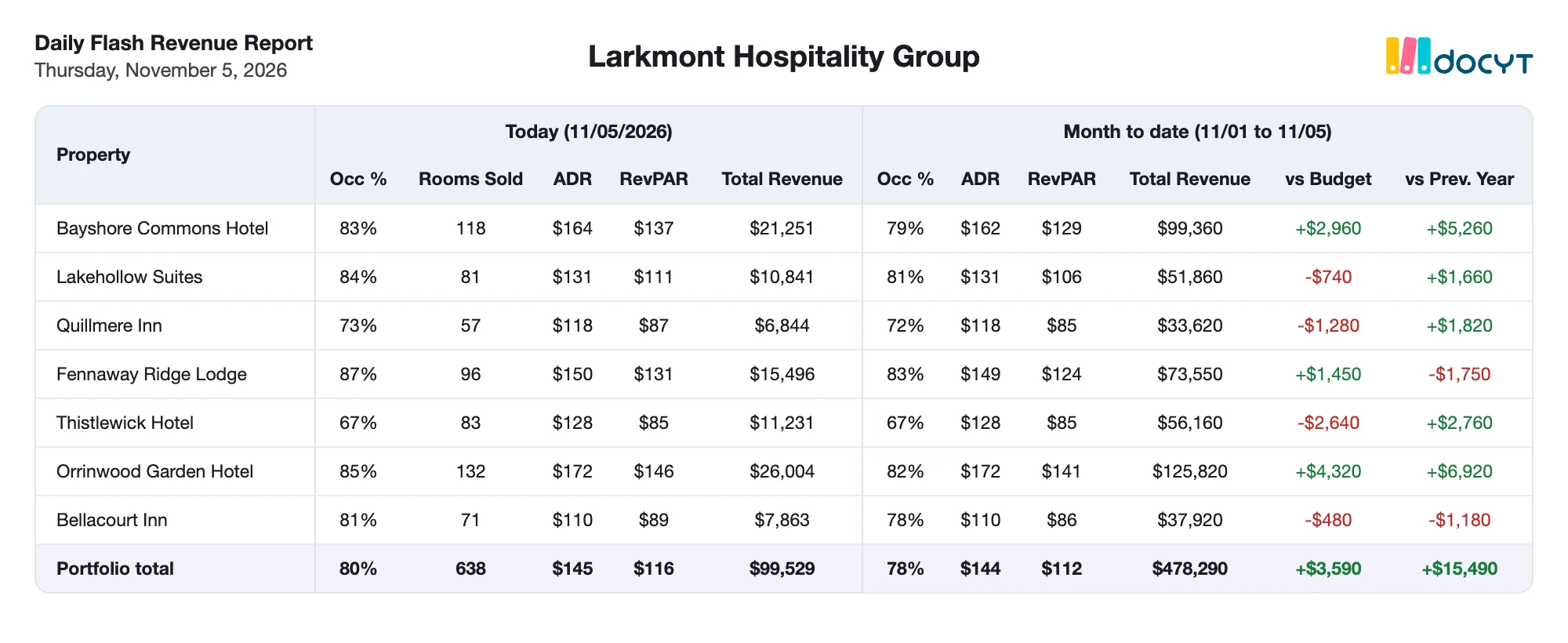
- Automate the daily flash report. Yesterday’s results by property should be waiting for your team in the morning, not assembled by them.
- Tighten access. Give each person their own credentials, set permissions by role and remove shared logins wherever possible.
How Docyt brings multi-brand revenue into one view
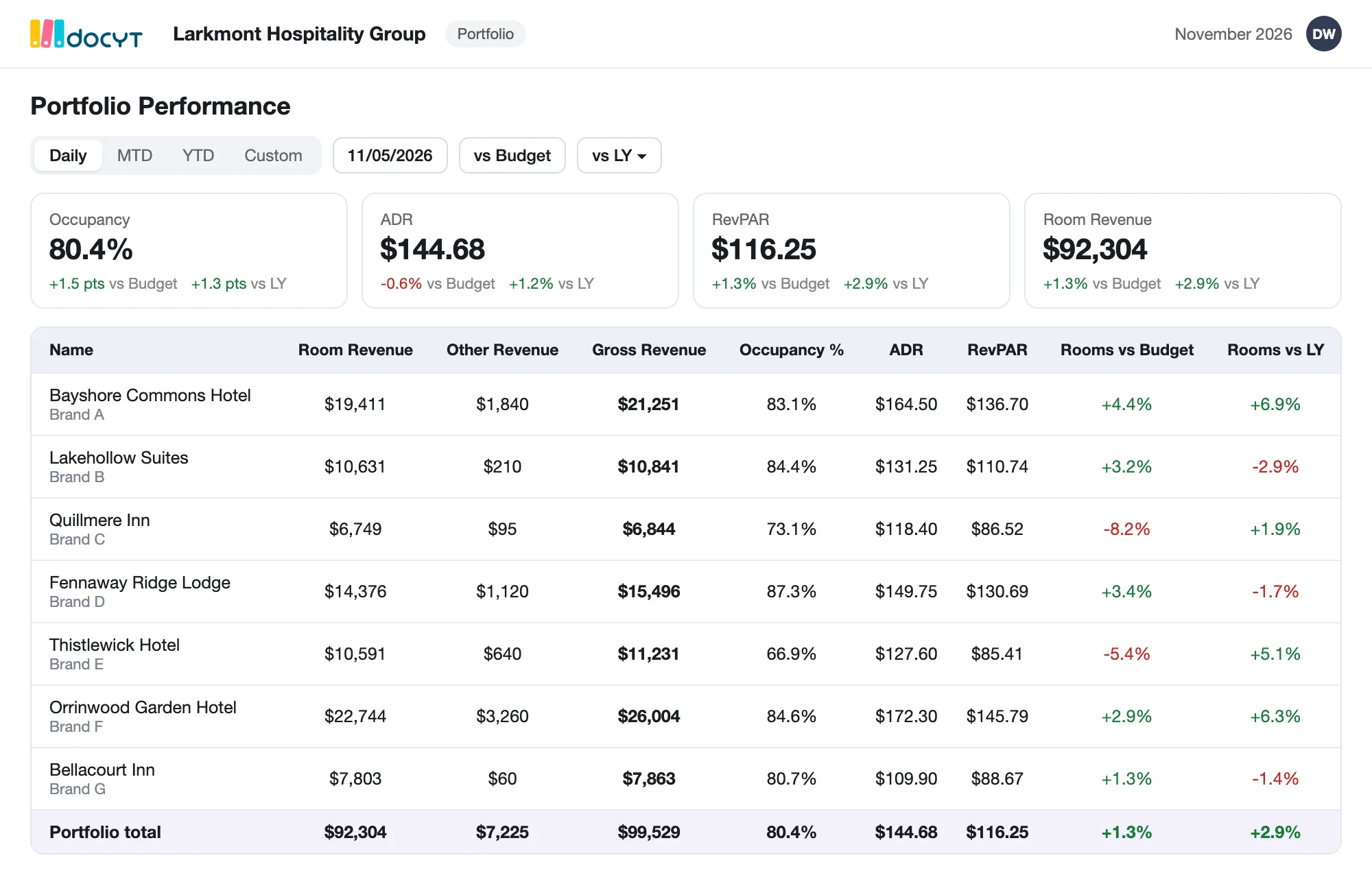
We built Docyt for exactly this kind of portfolio. Docyt connects to more than 30 PMS and POS systems and brings each property’s night audit data into one platform every day. From there, our business intelligence dashboards show occupancy, ADR, RevPAR and revenue for the full portfolio or any single hotel, with comparisons to budget and last year.
Because the same data also posts to your accounting, the numbers your team reviews in the morning match the numbers in your financial statements. Our Daily Flash Revenue Report summarizes the prior day’s performance by property, and role-based permissions let owners, regional leaders and GMs see their own view through one login.
When a question doesn’t fit a standard report, you can build a view by describing it. Our post on AI Dashboards for hotel portfolio reporting shows how that works.
To set expectations clearly: revenue data updates daily after each night audit, not minute by minute, and some brand-specific tasks will still happen in brand portals. What changes is that checking yesterday’s results no longer requires seven logins.
Summary: multi-brand hotel revenue reporting at a glance
- The problem: multi-brand portfolios often check daily revenue across many PMS and brand portals, each with its own login.
- The hidden costs: lost hours, inconsistent numbers, spreadsheet errors, shared-credential risk and slower decisions.
- What good looks like: one source of truth from the night audit, standard KPI definitions, portfolio and property views, and role-based access.
- Five steps: inventory logins, standardize KPIs, use the night audit as your source, automate the daily flash and tighten access.
- With Docyt: night audit data from 30+ PMS and POS systems feeds one set of dashboards and your accounting, updated daily.
See your whole portfolio in one place
If your mornings start with a stack of logins, there’s a simpler way. We’ll show you how Docyt brings multi-brand revenue into one daily view, using a portfolio like yours. Schedule time with Docyt to learn more.