
Halloween is the one night ghosts are welcome. In hotel accounting, they show up all year: commissions on nights no one stayed, payouts that never arrive, reservations that exist in one system and nowhere else. Most of them slip by because hotels treat hotel OTA reconciliation as a month-end task. On paper, that works. The problem is the calendar. By the time a controller finds a short-paid virtual card or a commission billed on a night the guest never stayed, the window to correct it has often closed, and revenue the property already earned becomes a cost of distribution.
Margins leave little room for that. The American Hotel & Lodging Association’s 2026 State of the Industry report found rising operating expenses kept GOPPAR at roughly 90 percent of 2019 levels. Revenue that was earned but never collected is one of the most avoidable losses on the P&L.
The usual suspects: where OTA revenue leakage hides
OTA revenue leakage rarely jumps out at you. It comes from small, repeatable hotel OTA billing errors that each look like a rounding difference:
- Virtual card underpayments: the card is issued for less than your contract says you are owed.
- Phantom commissions: a no-show or shortened stay is never updated with the OTA, so you pay commission on nights that never happened.
- Rate discrepancies: the OTA, PMS, and commission rates do not match.
- Fee variances: resort and ancillary fees settle inconsistently across channels. Since the FTC’s rule on unfair or deceptive fees took effect in May 2025, hotels must show total price including mandatory fees, so confirming each channel settles them correctly matters more.
- Ghost reservations and zombie balances: OTA bookings with no PMS match, and folio balances that linger long after checkout.
A booking can move through the OTA, channel manager, payment gateway, processor, PMS, bank, and general ledger. No single system owns the audit across all seven.
Anatomy of a haunting: one shortened stay
Illustrative numbers: a guest books three nights at $180 through an OTA with 18 percent commission, so the OTA expects $97.20. The guest leaves after two nights. Correct commission is now $64.80. If the stay change is never reported, the property overpays $32.40. Forty similar stays a month across a portfolio is more than $15,500 a year from one error type on one channel.
The check: expected commission = actual commissionable revenue × contracted rate. Any variance is an exception worth investigating.
Why monthly reconciliation shows up after midnight
Periodic accounting creates periodic visibility. By the time a month-end review surfaces a discrepancy, the guest has checked out, the OTA has settled, and the context to contest it has gone stale. Errors also multiply like a bad sequel: a misconfigured commission rule repeats on every affected booking until someone finds the root cause.
Some OTA extranets close the window to report a no-show 48 hours after the scheduled checkout date. A reconciliation that runs 30 to 45 days later finds that error long after it can be corrected there.
How to run daily OTA reconciliation (no séance required)
- Pull yesterday’s OTA activity at the reservation level, including modifications and no-shows.
- Match each reservation to the PMS by confirmation number. Unmatched bookings become exceptions.
- Compare nights, rate, fees, and payment against the expected payout or commission.
- Act inside reporting windows for no-shows and stay changes.
- Tie payouts to the bank and GL, then tag each exception’s root cause so it gets fixed at the source.
This is manageable for one property. Across a portfolio and several channels, it becomes a nightly vigil that is hard to sustain by hand.
How Docyt automates OTA reconciliation with AI
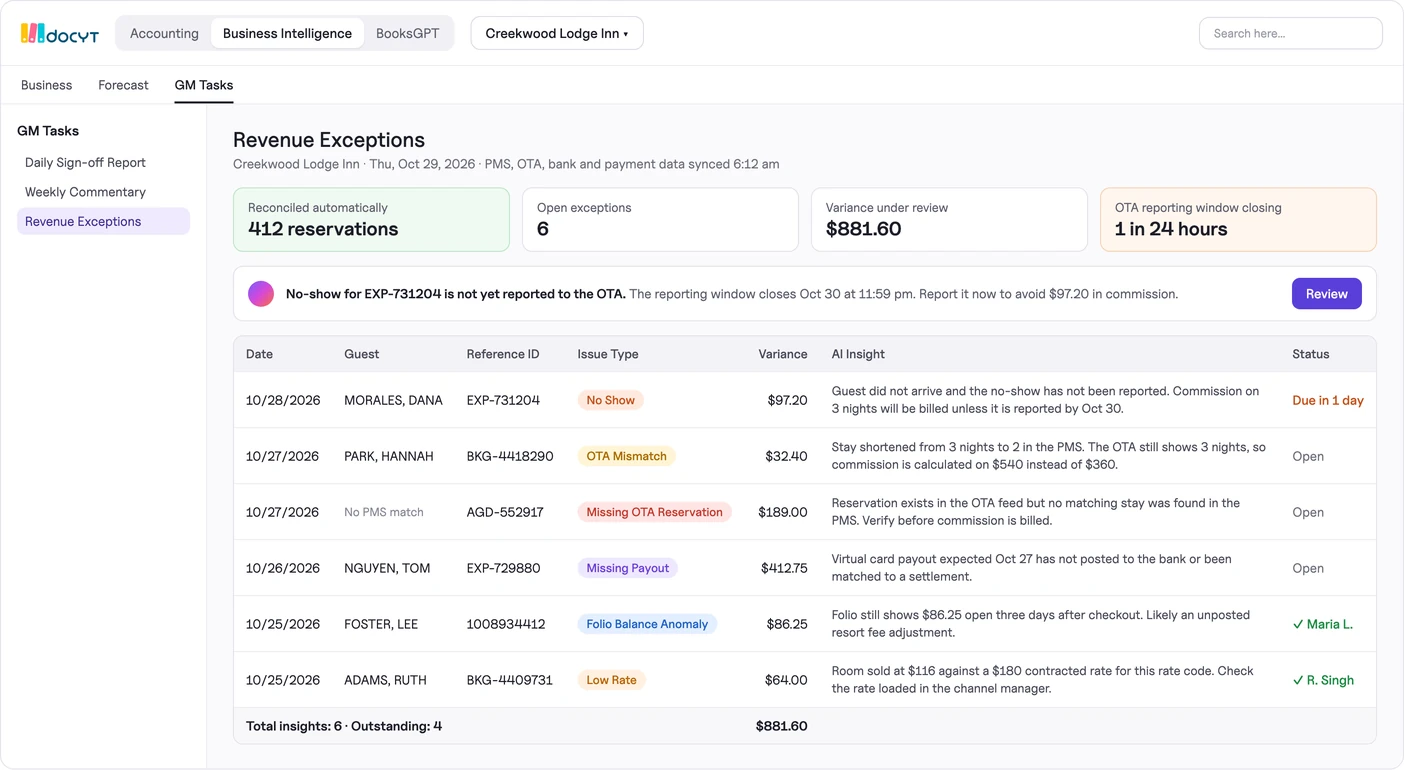
At Docyt, we built OTA reconciliation into the same continuous accounting engine that keeps the general ledger current every day. Our AI agents ingest PMS data, OTA channel feeds, bank transactions, and payment records, then reconcile them at the reservation level as data syncs each day. Think of it as a night watch for your revenue that never clocks out.
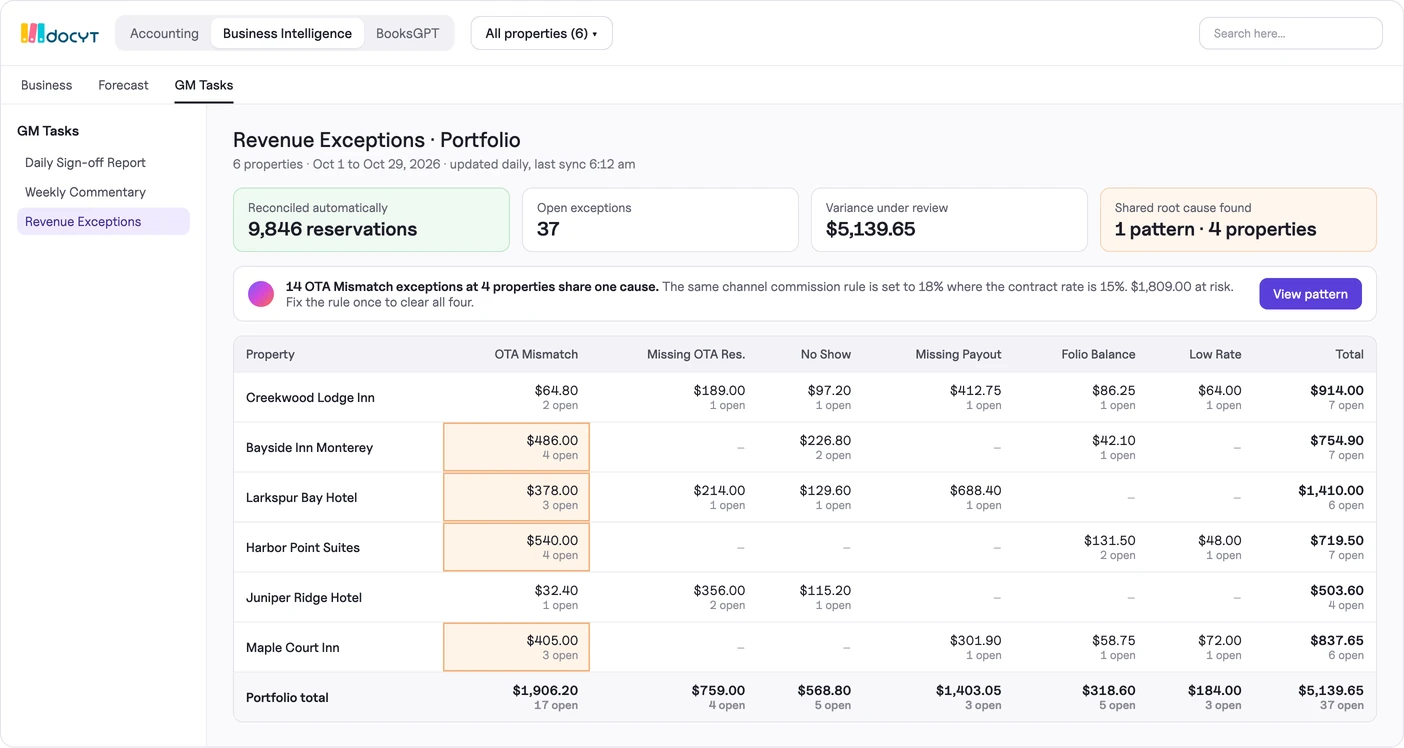
Everything that reconciles is handled automatically. In Revenue Exceptions, under GM Tasks in our Business Intelligence module, each remaining discrepancy is classified, paired with an AI-generated insight explaining what likely happened, and queued for review. Exception types include OTA Mismatch, Missing OTA Reservation, No Show, Missing Payout, Folio Balance Anomaly, and Low Rate Flag.
For a closer look at the folio side, see our breakdown of hotel folio exceptions.
Daily vs. monthly: what changes
| Monthly reconciliation | Daily, automated reconciliation | |
|---|---|---|
| When errors surface | 30 to 45 days after checkout | As data syncs each day |
| OTA correction window | Often closed | Typically still open |
| Level of detail | Channel or month totals | Individual reservation and folio |
| Recurring errors | Repeat for weeks | Patterns visible within days |
As we wrote in Why Month-End Close in Hotels Keeps Breaking, periodic accounting creates periodic blind spots. Real-time hotel revenue reconciliation closes them.
When one ghost becomes a haunted portfolio
Across a portfolio, OTA errors multiply. One commission misconfiguration running at ten properties creates roughly ten times the leakage. Docyt consolidates revenue exceptions by property, issue type, and dollar amount, updated daily, so a pattern across hotels can be fixed once.
Frequently asked questions
What is hotel OTA reconciliation?
Matching each OTA reservation, commission, and payout against the PMS stay, bank deposit, and general ledger to confirm the hotel was paid and charged correctly.
How often should hotels reconcile OTA revenue?
Daily, at the reservation level, because some OTA correction windows close within days of checkout.
Can OTA commission overpayments be recovered?
Often, if raised inside the OTA’s reporting window. Afterward, recovery depends on OTA policy and contract terms.
Don’t let earned revenue vanish into the night
Ghosts in your OTA revenue are not a once-a-year event. They are a routine part of multi-channel distribution. The question is whether your process finds them while the fix is still a correction instead of a claim. Daily, AI-driven reconciliation makes that the default, so the only scares on October 31 come from the trick-or-treaters.
Key takeaways on hotel OTA reconciliation
- OTA revenue leakage comes from small, repeatable billing errors across channels.
- Monthly reconciliation often finds them after OTA correction windows close.
- Daily, reservation-level reconciliation keeps discrepancies recoverable.
- Docyt’s AI agents reconcile PMS, OTA, bank, and payment data continuously and surface only true exceptions, consolidated across every property.
Find the ghosts in your OTA revenue before they disappear
Docyt is an AI-powered accounting and business intelligence platform built for hotel owners and operators. Schedule time with our team to see where OTA discrepancies are going unrecovered across your properties.