It is the third business day of the month. Your PMS says rooms revenue was one number. Your general ledger says another. Somewhere between the night audit and the P&L, a few thousand dollars went to the wrong place, and now someone has to find it line by line.
In most cases, the culprit is not a missing transaction. It is hotel rate code mapping: the rules that decide which accounts each PMS code posts to. When those rules drift out of date, revenue still posts every night. It just posts to the wrong accounts, and nobody notices until close.
Here is where that mapping usually breaks, what it costs you, and how to keep it clean.
Rate codes and transaction codes: two maps, not one
Your PMS uses two kinds of codes that matter to accounting, and they answer different questions:
- Rate codes describe how a room was sold: the price, the conditions, and usually the market segment, such as transient, group, corporate, or package.
- Transaction codes (also called charge or revenue codes) describe what was posted to a guest folio: room revenue, taxes, fees, food and beverage, parking, adjustments, and payments.
Accounting needs both maps to be right. Rate codes drive segment reporting and statistics like ADR. Transaction codes drive which general ledger accounts get credited. A clean night audit can still produce a wrong P&L if either map is off.
Where revenue breaks: 7 common mapping gaps
1. New codes that were never mapped
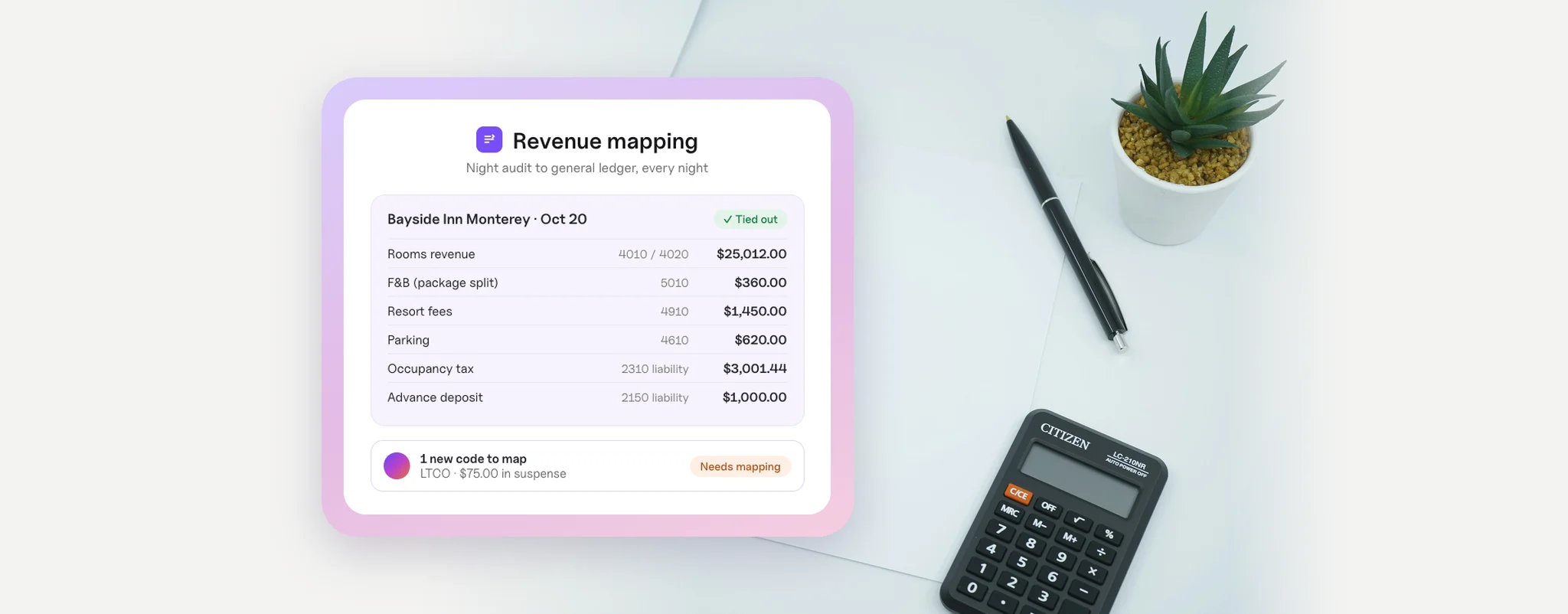
Revenue and sales teams create rate codes for promotions, groups, and negotiated accounts all the time. If a new code goes live before accounting maps it, its revenue either falls into a default account or lands in a suspense account waiting to be sorted out.
2. Packages posted as 100% room revenue
A rate that bundles a room with breakfast or parking needs an allocation rule. Without one, the full package price posts to rooms. Rooms revenue looks inflated, food and beverage looks light, and departmental margins stop meaning much.
3. Fees mapped to the wrong department
Resort or destination fees, parking, pet fees, early check-in, and late checkout charges each need a clear home. When they default to rooms revenue, ADR and RevPAR in the P&L no longer match what the PMS reports.
Fees are getting closer attention on the guest side too. The FTC’s Rule on Unfair or Deceptive Fees, which took effect May 12, 2025, requires short-term lodging businesses that advertise prices to disclose the total price, including mandatory fees, upfront. That changes how fees are displayed to guests. Your accounting still needs every fee code mapped to the right revenue account.
4. Taxes mixed into revenue
Occupancy and sales taxes are liabilities, not revenue. If a tax code is mapped to a revenue account, revenue is overstated and the tax liability you owe is understated.
5. Adjustments and allowances posted to the wrong place
Rebates, corrections, and allowances often use their own transaction codes. When they are not mapped against the right revenue lines, net revenue by department becomes unreliable, even when the property total looks right.
6. Balance sheet activity treated as revenue
Advance deposits, city ledger (direct bill) transfers, and guest ledger movements belong on the balance sheet. When these codes are mapped to revenue, both the P&L and your receivables are off.
7. The same code meaning different things across properties
In a portfolio, one property’s code for a corporate rate might be another property’s code for a package. If each hotel maps codes on its own, consolidated reports compare unlike things. We cover this portfolio problem in more depth in our post on how night audit revenue should post to the general ledger.
Warning signs your PMS to general ledger mapping has drifted
- Your daily revenue report and the general ledger do not tie, and the gap changes every day.
- ADR or rooms revenue in the P&L differs from what the PMS reports for the same period.
- A revenue suspense or clearing account keeps growing month over month.
- Food and beverage or other departments look weaker on paper than operators say they are.
- Month-end close includes a recurring “fix the revenue mapping” task.
How to fix hotel rate code mapping and keep it clean
- Inventory every code. Export all active rate codes and transaction codes from each property, including the ones you think are retired.
- Map to a standard chart of accounts. Align every transaction code to a consistent chart of accounts across properties. The 12th Revised Edition of USALI takes effect January 1, 2026, and HFTP has outlined the key changes finance teams should plan for. Our USALI 12th Edition chart of accounts reference walks through where each account belongs.
- Set allocation rules for packages and fees. Decide how each bundled component is split across departments, and document it.
- Require mapping before a code goes live. Make accounting sign-off part of creating any new rate or transaction code.
- Tie out daily, not monthly. Compare each night’s audit totals to what posted in the general ledger, and clear unmapped items the next morning while the context is fresh.
How we handle rate code mapping at Docyt
We built Docyt so revenue mapping is checked every night, not discovered at month-end.
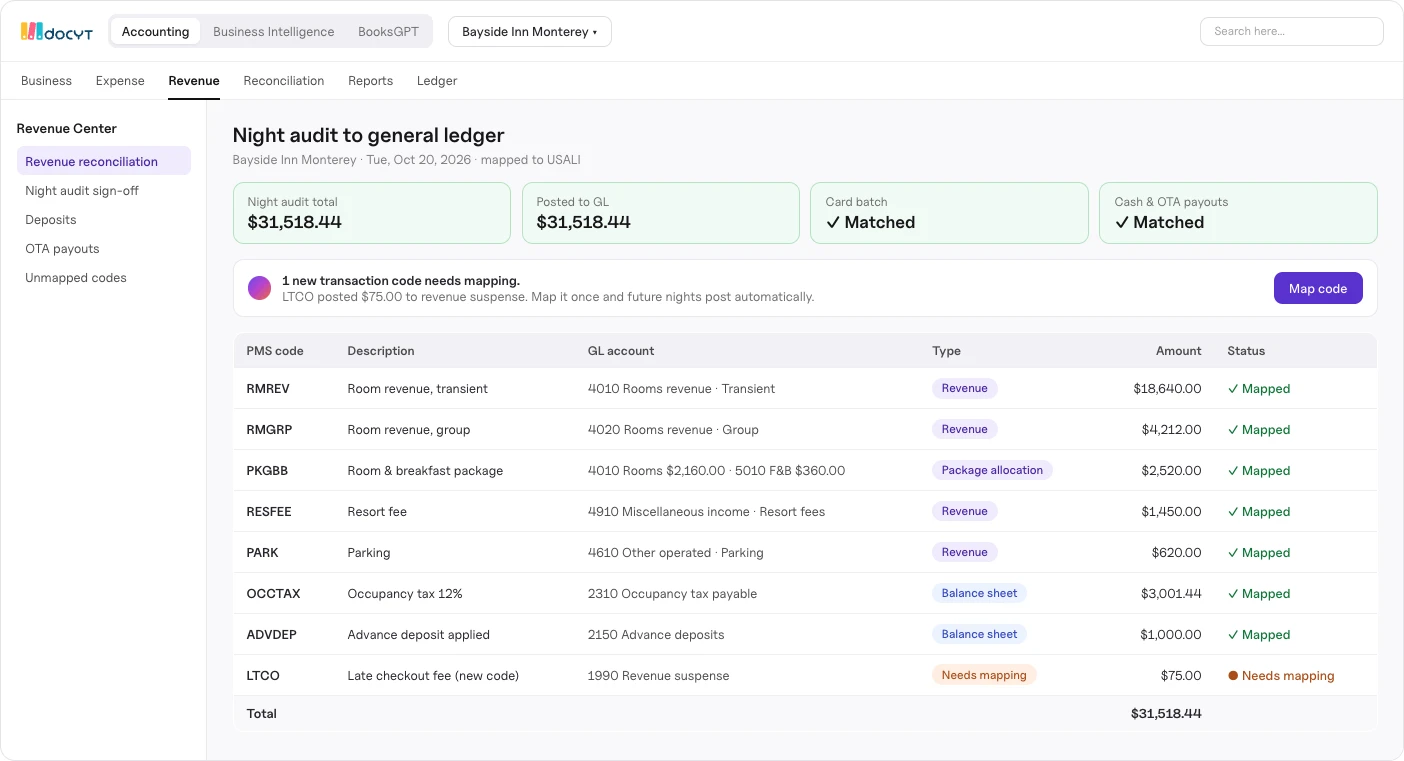
- Nightly revenue reconciliation. Docyt posts night audit and POS reports nightly, maps them to USALI, and ties them to card batches, cash, and OTA payouts.
- Night audit sign-off. Each night’s revenue can be approved in one click, with exceptions routed to accounting instead of waiting for close.
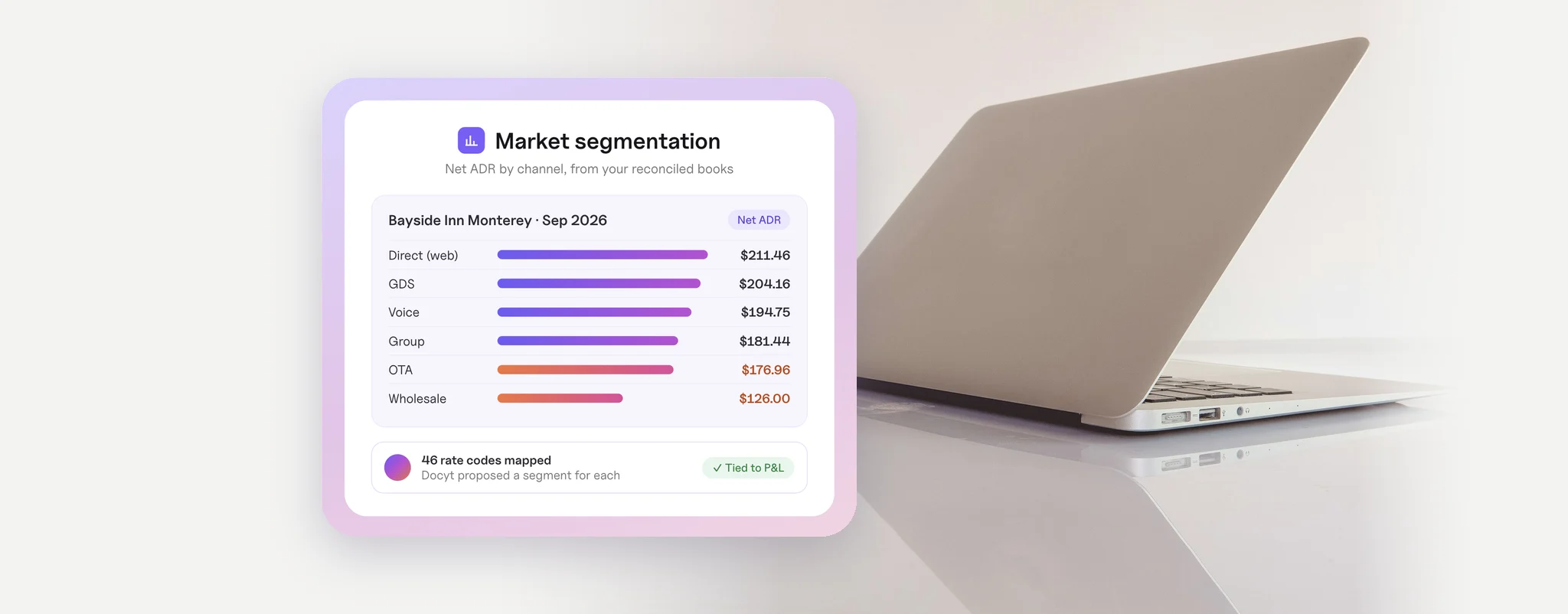
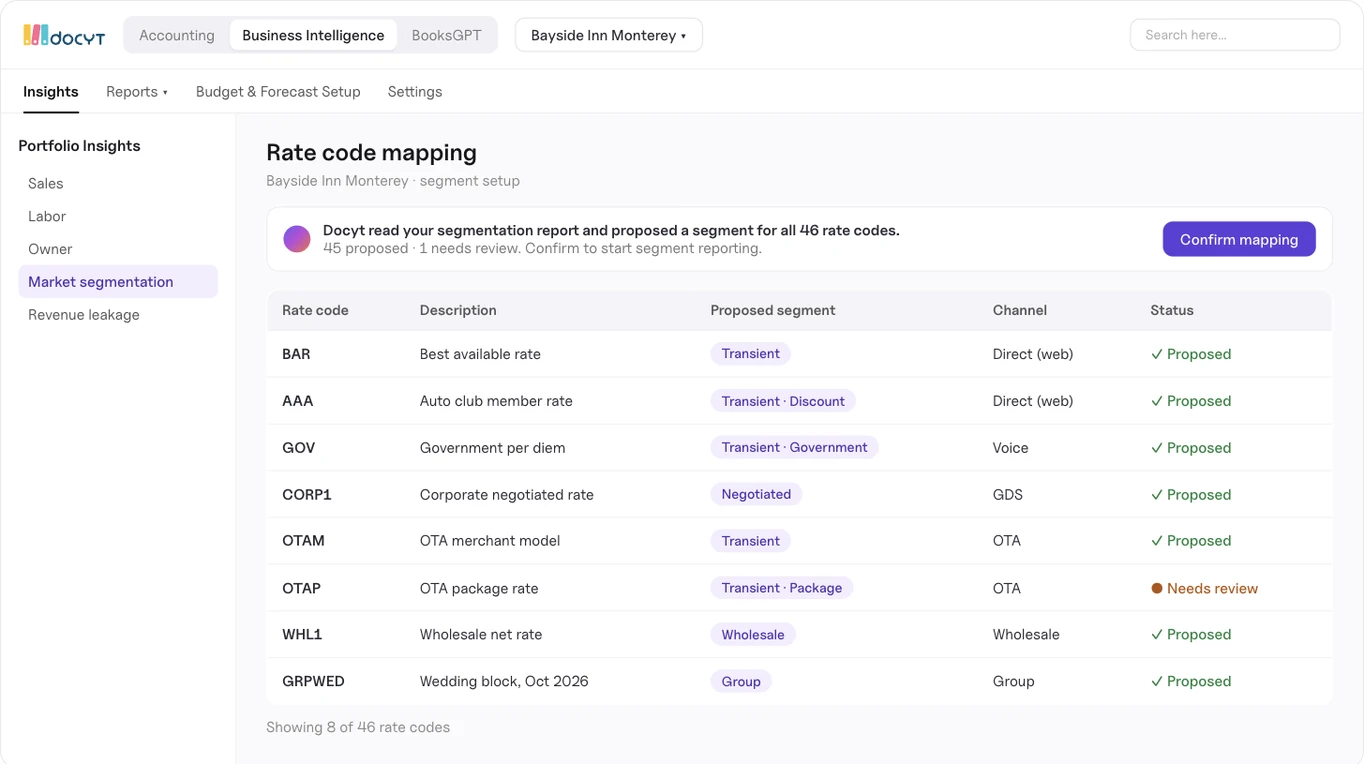
- Rate codes mapped to segments. Docyt reads a property’s segmentation report and proposes a market segment for every rate code, so setting up segment reporting takes minutes instead of a manual mapping exercise.
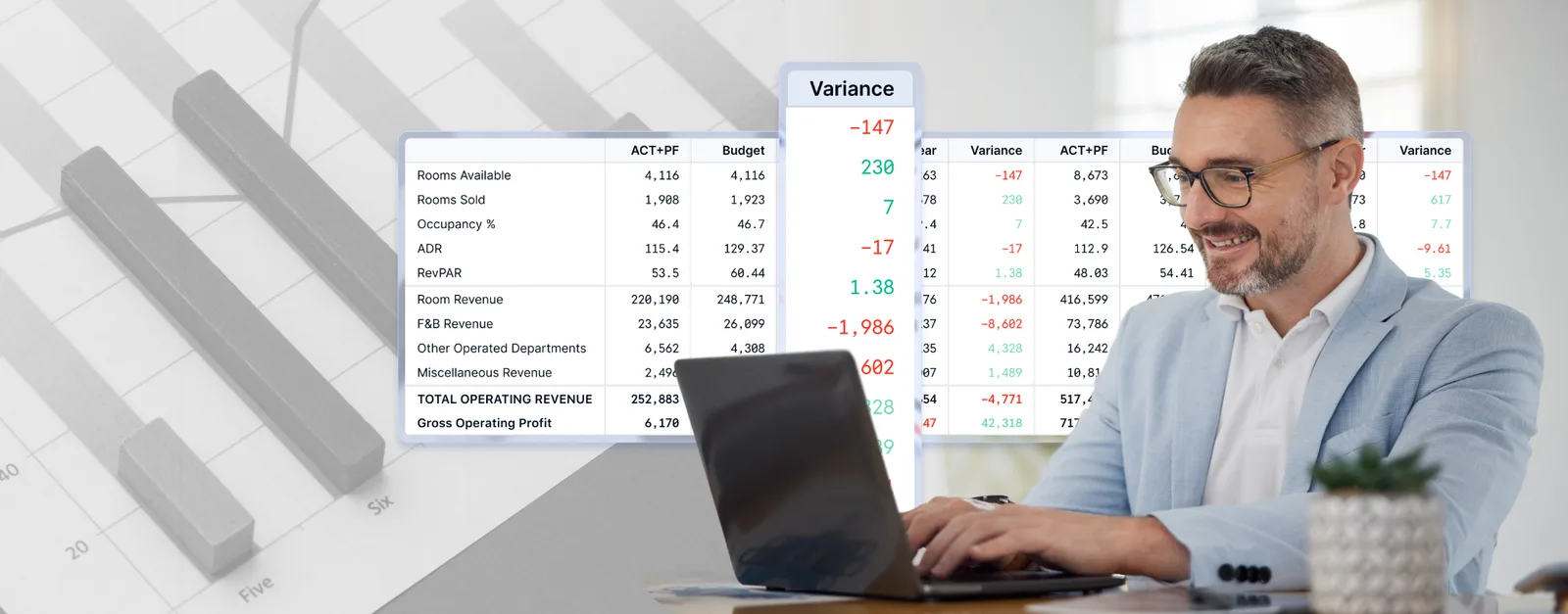
- Revenue numbers you can share. Our Daily Revenue Flash Report delivers revenue, occupancy, ADR, and RevPAR for each property and the portfolio by 7 am, built from reconciled actuals.
Frequently asked questions
What is hotel rate code mapping?
Hotel rate code mapping is the set of rules that connects PMS codes to accounting and reporting. Rate codes map to market segments and statistics, and transaction codes map to general ledger accounts.
Why doesn’t my PMS revenue match my general ledger?
The most common causes are unmapped or outdated codes, package revenue posted entirely to rooms, fees or taxes mapped to the wrong accounts, and balance sheet activity like deposits mapped as revenue.
How often should hotels review PMS code mapping?
Check for unmapped codes daily as part of your revenue tie-out, and review the full mapping whenever new rate or transaction codes are created, a property joins the portfolio, or your chart of accounts changes.
Summary overview
- Hotels need two maps: rate codes to segments and statistics, and transaction codes to general ledger accounts.
- Revenue breaks when codes go unmapped, packages post fully to rooms, fees or taxes hit the wrong accounts, or deposits are treated as revenue.
- Warning signs include daily revenue that will not tie, a growing suspense account, and ADR that differs between the PMS and the P&L.
- Fix it with a code inventory, a standard USALI-aligned chart of accounts, allocation rules, mapping before go-live, and daily tie-outs.
- Docyt reconciles night audit revenue nightly, maps it to USALI, and flags exceptions before month-end.
Stop chasing revenue at month-end
If your team spends the first days of every close reconciling PMS revenue to the general ledger, we can help. Schedule time with our team to see how Docyt maps and reconciles hotel revenue every night across your properties.