Building or auditing a hotel chart of accounts usually means flipping between a GL export and the USALI manual, trying to confirm which schedule a given line actually belongs to. This reference is built to shortcut that search: a schedule-by-schedule walkthrough of what the USALI 12th Revised Edition covers and representative line items you would expect to find in each, so a controller mapping a property’s accounts has a quick lookup instead of a full manual read.
What the 12th Edition Changed
The Hospitality Financial and Technology Professionals association released the 12th Revised Edition of the Uniform System of Accounts for the Lodging Industry through its Global Finance Committee, adding a mandatory labor-hours schedule, a new brand and operator cost schedule, and expanded guidance for all-inclusive properties and standalone lounge reporting. Full detail on the brand and operator cost changes is in HFTP’s Schedule 16 deep dive, and the logic for classifying newer revenue types like grab-and-go is covered in HFTP’s other reporting guidance deep dive.
This reference covers what each schedule contains. For the methodology on mapping a mixed portfolio’s actual GL accounts into this structure consistently, without forcing identical accounts onto structurally different properties, see our companion piece on standardizing a chart of accounts across hotel brands and property types.
Schedule-by-Schedule Reference
Schedule 1, Rooms.Transient and group room revenue, other rooms revenue such as attrition and cancellation fee income, and direct expenses including reservations, front desk payroll, and housekeeping payroll and contract cleaning.
Schedule 2, Food and Beverage.Revenue by outlet and by banquet or catering function, plus direct cost of food, cost of beverage, and outlet and banquet payroll. Minibar food and beverage are no longer tracked as separate accounts under the 12th edition and roll into the applicable outlet instead.
Schedule 3, Other and Minor Operated Departments.Revenue-generating departments outside Rooms and F&B, such as spa, golf, parking, and marina, each carrying its own direct revenue and expense rather than being folded into Miscellaneous Income.
Executive or Club Lounge.New as a standalone schedule in the 12th edition, reported with the same level of detail as an F&B venue. Upcharge or premium revenue from paid lounge access, and the direct operating cost of running it, no longer sit buried inside Rooms or F&B.
Miscellaneous Income.Revenue that falls outside Rooms and F&B, reported net rather than gross, covering items like commissions and other incidental income that do not belong to a specific operating department.
Undistributed Operating Expenses.Administrative and General, Sales and Marketing, Property Operations and Maintenance, and Utilities. These schedules absorb costs that benefit the whole property rather than one department, and sit below departmental income on the statement, not mixed into it.
Schedule 15, Payroll FTE.New in the 12th edition. Tracks employee hours by operating and undistributed department rather than dollars, giving portfolios a labor-efficiency metric that payroll cost alone does not capture.
Schedule 16, Annual Mandatory Brand and Operator Costs.New in the 12th edition. Consolidates mandatory brand and operator fees, reservations, marketing, IT, and centralized programs, into one annual schedule. Optional owner-directed services and pass-through costs like travel agent commissions are explicitly excluded.
Management Fees.Base and incentive management fees, kept as their own schedule rather than folded into Undistributed Operating Expenses or Schedule 16.
Non-Operating Income and Expenses.Items below Gross Operating Profit, including rent, property and other taxes, insurance, and interest, depreciation, and amortization, none of which reflect operating performance at the property level.
The Rule That Does Not Change
Every operating department schedule reports on a responsibility basis: revenue and the direct expenses of running that department only, before any undistributed cost is allocated to it. Posting an undistributed cost, like a corporate marketing charge, directly into a department schedule is one of the most common mapping errors, and it breaks comparability the moment that property gets benchmarked against the rest of a portfolio or a brand set.
Using This Reference in Practice
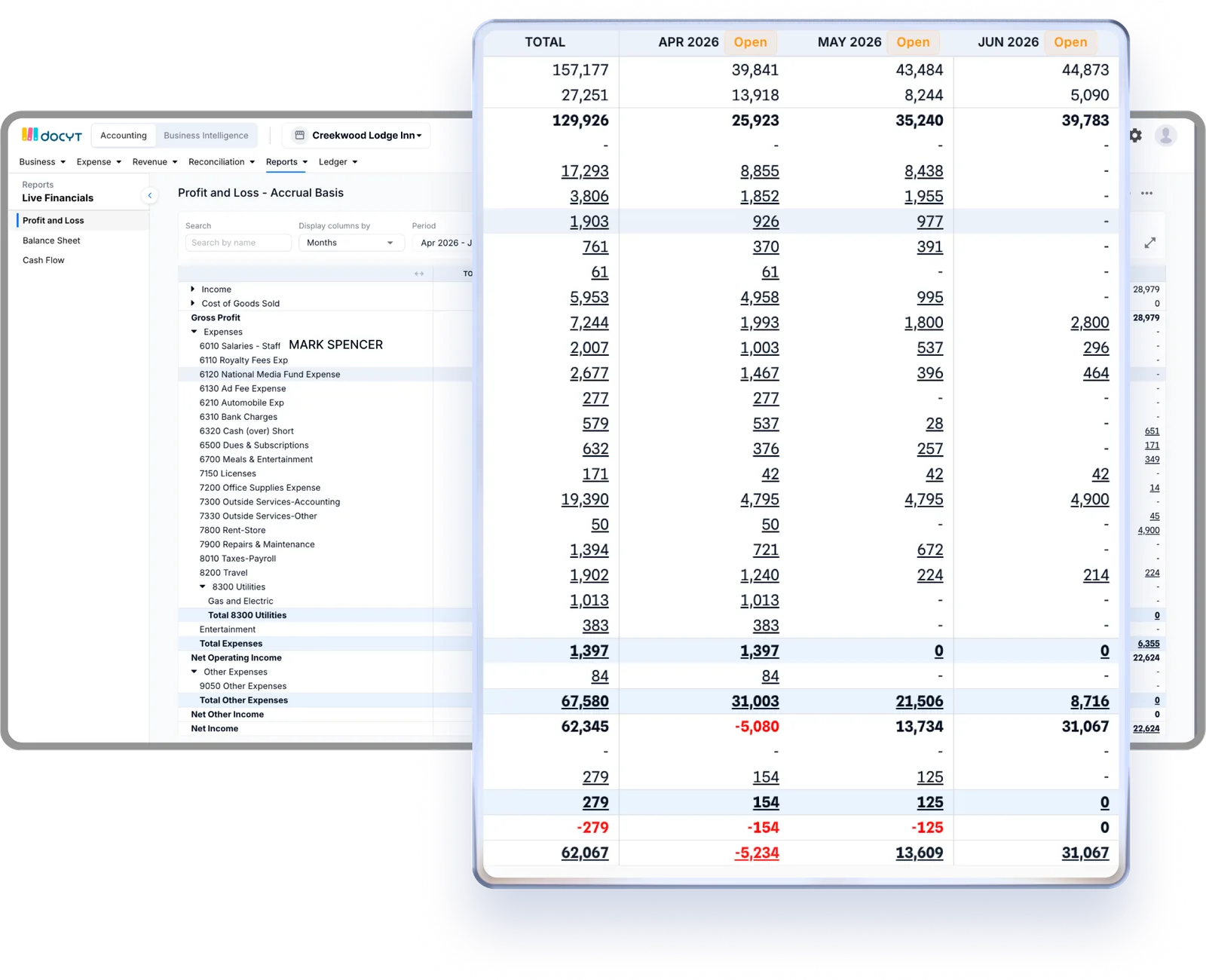
A schedule reference tells you where an account belongs. It does not, by itself, keep every property in a portfolio mapping into it the same way as the portfolio grows and adds different property types. That is the mapping problem we walk through in Standardizing a Chart of Accounts Across Hotel Brands and Property Types. Docyt applies a portfolio’s chart of accounts against this schedule structure automatically as transactions post, so a controller reviews the mapping instead of rebuilding it property by property. See how this works on our hospitality accounting automation page.
Summary Recap:
- The 12th edition added Schedule 15 (Payroll FTE), Schedule 16 (Annual Mandatory Brand and Operator Costs), a standalone Executive or Club Lounge schedule, and expanded all-inclusive guidance.
- Departmental schedules (Rooms, F&B, Other and Minor Operated Departments) report revenue and direct expense only, on a responsibility basis, before undistributed costs are allocated.
- Undistributed Operating Expenses, Management Fees, and Non-Operating Income and Expenses sit below departmental income, not mixed into it.
A schedule reference tells you where an account belongs. A standardized mapping framework keeps every property in a portfolio placing it there consistently.
Ready to see this schedule structure applied across your own portfolio?
Schedule time with Docyt to walk through how your properties’ charts of accounts map today.