It’s the monthly owner call. Your GM opens with good news: gross operating profit is up and the hotel beat budget. Then the owner asks a fair question. If GOP is up, why is the cash available for distribution flat?
Nobody made a mistake. The GM is reading the operator’s operating statement, and the owner is reading the owner’s statement. Both follow the Uniform System of Accounts for the Lodging Industry (USALI), and both start from the same numbers. They simply stop at different lines and hold different people accountable for what’s below them.
In this guide, we’ll walk through the owner’s statement vs. operating statement line by line: where they match, where they split, and why the gap matters more than ever in 2026.
A Quick Refresher on USALI
USALI is the standard format hotels use to report financial results. It’s published by Hospitality Financial and Technology Professionals (HFTP), and its revisions are overseen by the Global Finance Committee, which is sponsored jointly by HFTP and the American Hotel & Lodging Association. The 12th Revised Edition of USALI took effect on January 1, 2026.
Because USALI gives every hotel the same structure, an owner can compare properties, a lender can compare deals, and a management company can benchmark its portfolio. That shared structure is also why the owner’s and operator’s statements look identical at the top.
Where Both Statements Match: Revenue Down to GOP
From the top line down to gross operating profit (GOP), both statements use the same USALI accounts and the same order:
- Operating revenue by department: rooms, food and beverage, other operated departments and miscellaneous income
- Departmental expenses for each of those departments
- Departmental profit, which is revenue minus departmental expenses
- Undistributed operating expenses: administrative and general, information and telecommunications systems, sales and marketing, property operation and maintenance, and utilities
- Gross operating profit (GOP), which is total departmental profit minus undistributed operating expenses
If the two versions of your statement don’t agree down to GOP, that’s a mapping or timing problem, not a difference in format. More on that below.
The Operator’s Operating Statement: Built Around GOP
The operator runs the hotel day to day, so the operator’s operating statement focuses on the results management can directly influence: revenue, payroll, departmental costs and overhead. GOP is the operator’s scorecard. It’s also a common basis for incentive management fees in management agreements, which is one more reason operators watch it closely.
What the operator’s view usually leaves out is just as important. Costs like property taxes, insurance, ground rent and the reserve for future furniture, fixtures and equipment (FF&E) are real, but they’re generally outside the GM’s control. On many operator reports, they either don’t appear or sit in a short section the operator isn’t measured on.
The Owner’s Statement: Following the Money Past GOP
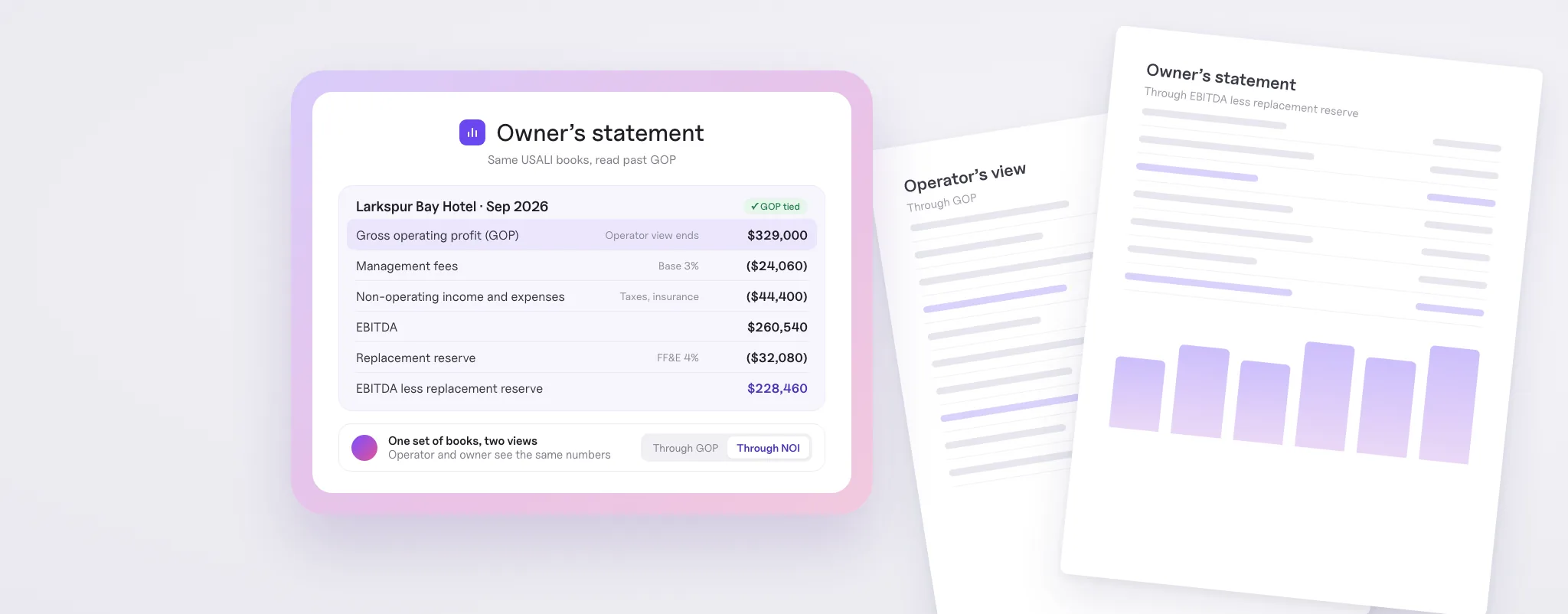
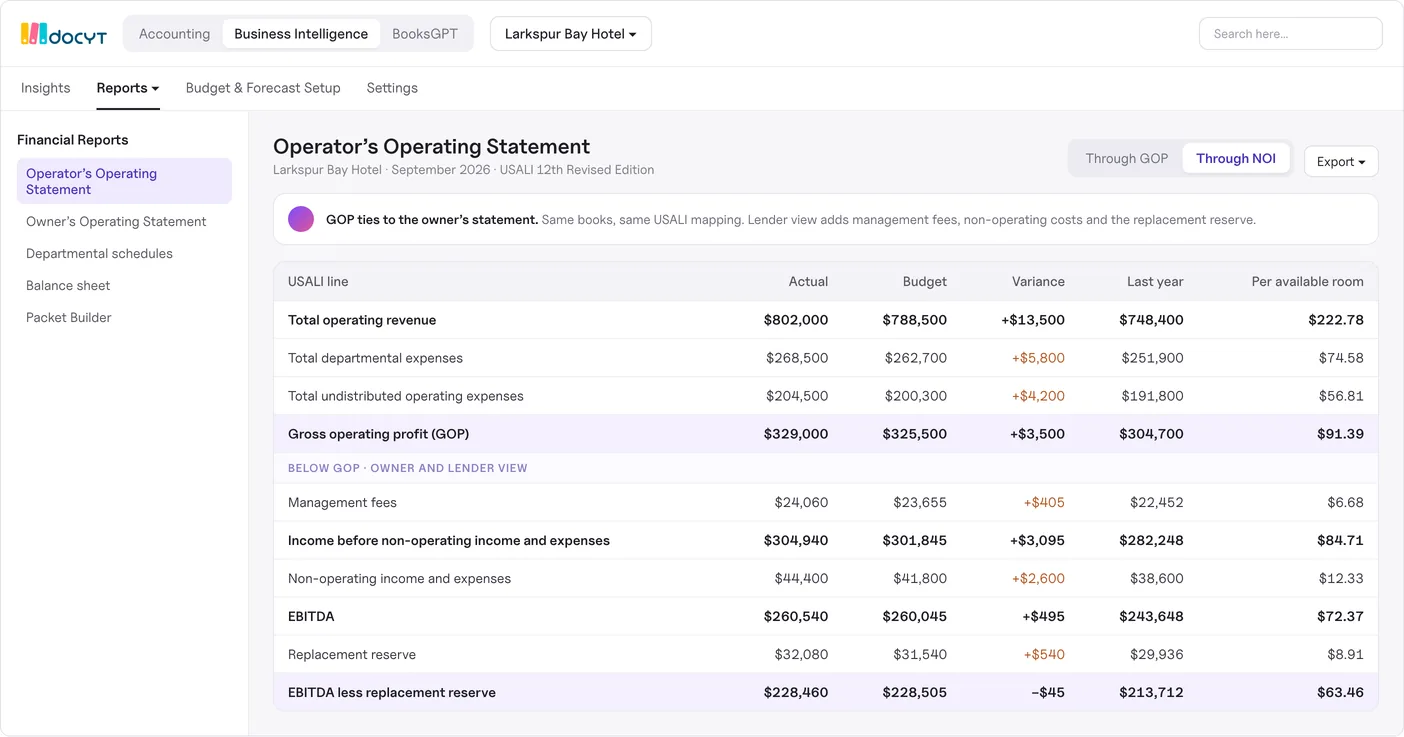
The owner’s statement starts with the same GOP and keeps going. Under USALI, the lines below GOP are:
- Management fees: base and incentive fees paid to a third-party operator. This line normally doesn’t apply when the same company owns and operates the hotel.
- Income before non-operating income and expenses: what’s left after management fees
- Non-operating income and expenses: items not generated by day-to-day operations, such as rent, property and other taxes, insurance, and other owner-level costs
- EBITDA: earnings before interest, taxes, depreciation and amortization
- Replacement reserve: the amount set aside to replace FF&E over time
- EBITDA less replacement reserve: the bottom line of the USALI operating statement
A note on terms: many owners and lenders still call this area of the statement net operating income, or NOI. USALI replaced “net operating income” with EBITDA starting with its 11th edition, but you’ll still hear both, and many lender reports still use NOI.
The USALI operating statement stops before debt service. Owners, though, also answer to lenders and partners, so many owner reporting packages go one step further and add interest, depreciation and amortization, and income taxes to reach net income. Those lines live outside the USALI operating statement, but they’re often what decides whether an owner can make a loan payment or a distribution.
Owner’s Statement vs. Operating Statement at a Glance
| Line or section | Operator’s operating statement | Owner’s statement |
|---|---|---|
| Revenue, departmental expenses and departmental profit | Included | Included |
| Undistributed operating expenses | Included | Included |
| Gross operating profit (GOP) | Included; the main measure of performance | Included |
| Management fees | Sometimes shown | Included |
| Non-operating income and expenses (rent, property taxes, insurance, other) | Usually not the focus | Included |
| EBITDA | Usually not the focus | Included |
| Replacement reserve and EBITDA less replacement reserve | Usually not included | Included |
| Interest, depreciation and amortization, income taxes | Not included | Often added for lender and partner reporting |
Exact formats vary by management agreement and owner. Treat this table as the typical pattern, not a rule.
Why the Gap Matters More in 2026
For several years, rising room rates covered a lot of ground. Today, many owners are seeing healthy revenue that doesn’t turn into the same healthy profit, because labor, insurance, utilities and brand and operator charges keep climbing. That’s exactly the kind of story that only shows up when you read past GOP.
USALI’s 12th edition makes part of that story easier to see. It adds a new schedule that brings together all mandatory costs charged by brands and management companies in one place, instead of spreading them across the statement. CBRE Hotels’ summary of the USALI 12th edition changes recommends that owners work with their brand and operator to understand every expense billed to the hotel. For owners, that schedule is a natural companion to the owner’s statement.
Five Common Reasons the Two Statements Don’t Tie
When the owner’s and operator’s versions of the same month disagree, it’s usually one of these:
- Different cutoff dates. The operator closes the books on one day and the owner’s package is built from a later version with more adjustments.
- Owner costs booked outside the property’s books. Insurance or property taxes paid at the ownership level may never reach the hotel’s ledger.
- Different management fee calculations. The fee in the owner’s package is calculated from the agreement, while the operator’s estimate is based on preliminary results.
- Reserve timing. One version shows the replacement reserve as accrued each month, the other shows it only when it’s funded.
- Chart of accounts mapping. Accounts mapped to different USALI lines, especially after the 12th edition reclassified costs like loyalty programs, move dollars above or below GOP.
How to Keep Both Statements Telling the Same Story
- Use one USALI-aligned chart of accounts across every property, so GOP means the same thing everywhere.
- Tie GOP first. Before reviewing anything below the line, confirm both versions agree on GOP. If they don’t, fix the mapping before the meeting.
- Show both views from the same data. Avoid rebuilding the owner’s statement in a separate spreadsheet. Every manual copy is a chance for the numbers to drift.
- Compare to budget every time. Variances below GOP, like insurance renewals or tax reassessments, are easy to miss until they hit the distribution.
- Don’t wait for month end. The sooner you see revenue and costs, the fewer surprises reach the owner’s statement. Our guide to the top accounting metrics every hotel owner should track covers where to start.
How Docyt Shows Both Views From the Same Books
At Docyt, we built our hospitality reporting so owners and operators can look at the same numbers without maintaining two sets of spreadsheets. Our AI-powered accounting platform keeps your books up to date and produces USALI financial statements in real time, so both views come from one source.
- Owner’s Operating Statement with columns for budget comparison, last year, per available room and per occupied room, and exports to Excel or PDF.
- Operator’s Operating Statement that opens Through GOP, with a lender view through NOI on a single toggle.
- Multi-property reporting that lets management companies compare and consolidate results across their portfolio.
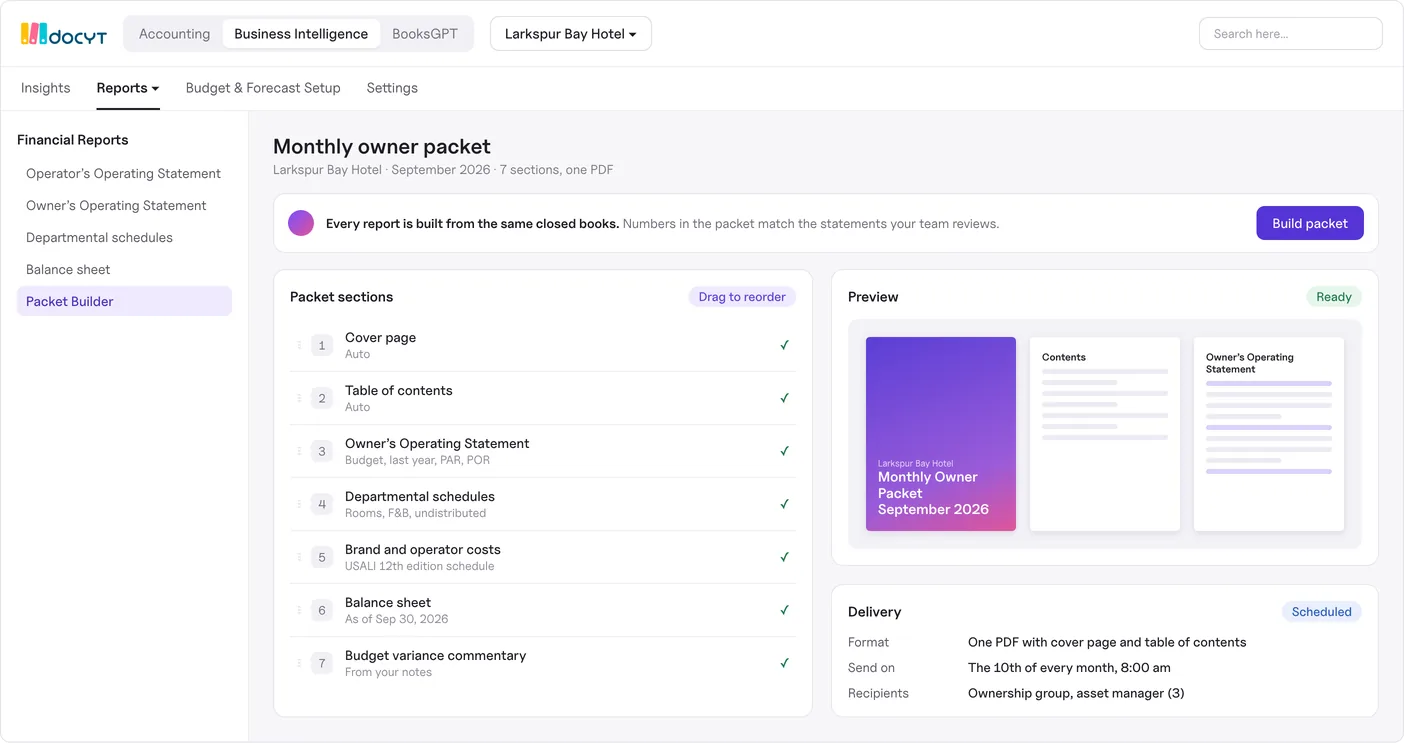
- Packet Builder, which assembles a monthly owner packet into one PDF with a cover page and table of contents, and can email it on a schedule.
Learn more about how we support hotel owners and management companies on our hospitality accounting page.
Frequently Asked Questions
What is the main difference between an owner’s statement and an operating statement?
Both follow the same USALI format down to gross operating profit. The operator’s operating statement focuses on GOP, which management controls. The owner’s statement continues below GOP to management fees, non-operating costs like property taxes and insurance, EBITDA and the replacement reserve.
Where does the USALI operating statement end?
The USALI summary operating statement ends at EBITDA less replacement reserve. Interest, depreciation and amortization, and income taxes are outside it, though many owners add them for lender and partner reporting.
Is NOI the same as EBITDA in hotel accounting?
They describe the same area of the statement. USALI replaced the term net operating income with EBITDA starting with its 11th edition, but many owners and lenders still use NOI.
Summary overview
- Under USALI, the owner’s statement and operator’s operating statement are identical from revenue down to gross operating profit (GOP).
- The operator’s operating statement is built around GOP, the results management directly controls.
- The owner’s statement continues to management fees, non-operating income and expenses, EBITDA, the replacement reserve and EBITDA less replacement reserve.
- Many owner packages add interest, depreciation and amortization, and income taxes for lenders and partners. These sit outside the USALI operating statement.
- If the two versions disagree, start by tying GOP, then check cutoff dates, owner-level costs, management fee calculations, reserve timing and account mapping.
- USALI’s 12th edition, effective January 1, 2026, adds a schedule that gathers brand and operator costs in one place, which gives owners a clearer view below GOP.
See Both Statements From One Set of Books
We’d love to show you how Docyt keeps your owner’s and operator’s statements in sync across every property, in real time.