Every hotel closes its business day at night audit, but what happens to the night audit reports afterward varies by property. When a pack is incomplete or a day goes missing, the gap usually surfaces at month-end, when it is harder to fix.
A defined night audit report pack is one of the simplest controls a controller can put in place. Here is what we recommend it include, who should receive each report, and how to catch a missing day early.
In this article: Why it matters | What to send | Who gets it | How to catch a missing day | How finance teams automate this
Why the Night Audit Report Pack Matters to Accounting
Night audit finalizes daily revenue, payments, and guest balances. Accounting uses those totals to post revenue, reconcile deposits, and close the month. Our guide on how night audit revenue should post to the general ledger walks through that flow.
Consistency is the challenge. Night audit often falls to front desk staff, and the Bureau of Labor Statistics reports that on-the-job training was required for 97.4 percent of hotel desk clerks in 2025. A documented pack gives every auditor the same standard.
What to Send: The Core Report Pack
For every business date, accounting needs:
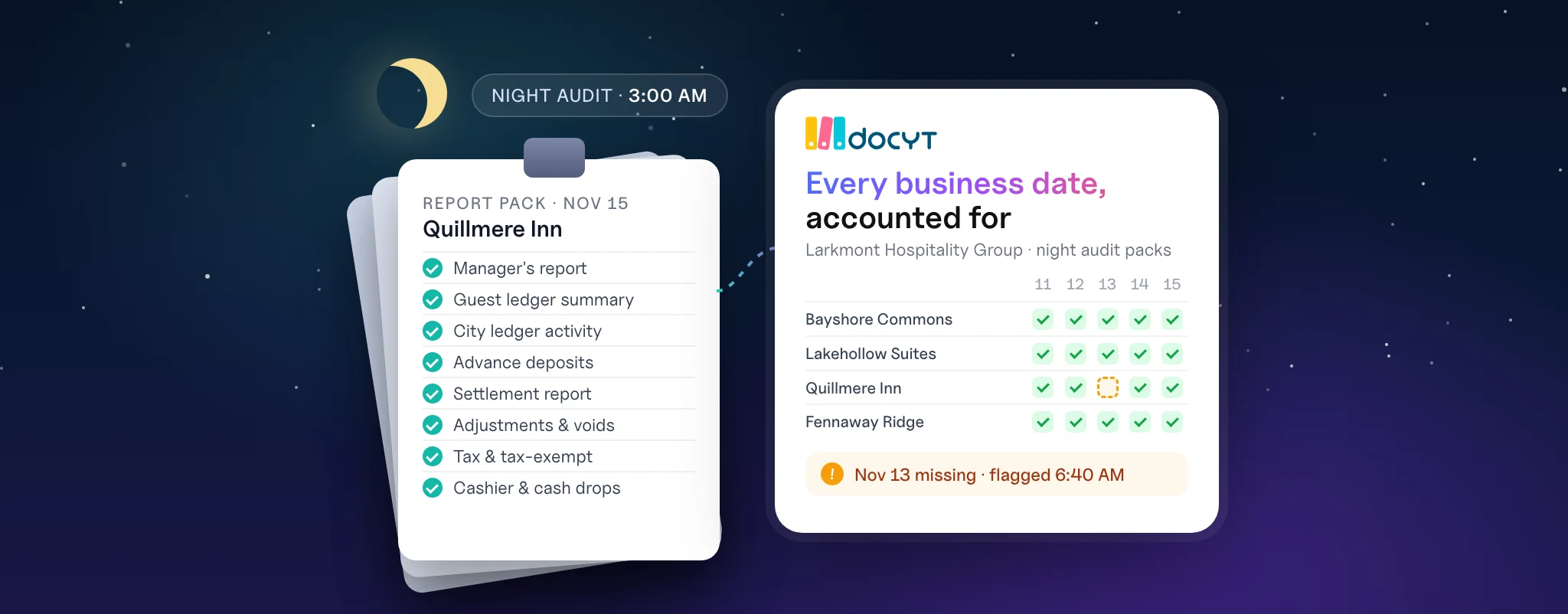
- Manager’s report (daily flash): revenue by department, occupancy, ADR, and RevPAR.
- Guest ledger summary: opening balance, charges, payments, and closing balance.
- City ledger activity: direct bill charges moved to accounts receivable.
- Advance deposit ledger: deposits received, applied, and refunded.
- Settlement report: card and cash totals tied to the credit card batch.
- Adjustments and voids: each correction with a reason code and approver.
- Tax and tax-exempt report: taxes collected and documented exemptions.
- Cashier and cash drop report: cash collected by shift.
The 12th Revised Edition of the Uniform System of Accounts for the Lodging Industry (USALI) has a January 1, 2026 adoption date, so confirm your night audit revenue codes match its categories.
Who Gets It
| Report | Primary recipient | Why they need it |
|---|---|---|
| Full pack | Controller or property accountant | Revenue posting and reconciliation |
| Manager’s report | General manager | Daily performance follow-up |
| Adjustments and voids | GM and controller | Approval and loss prevention |
| City ledger activity | Accounts receivable | Billing and collections |
| Daily flash summary | Owner or asset manager | Portfolio visibility |
How to Catch a Missing Night Audit Day
A missing day is easy to overlook across properties. Audits get rerun, files fail to send, and packs get misdated. Four checks catch it:
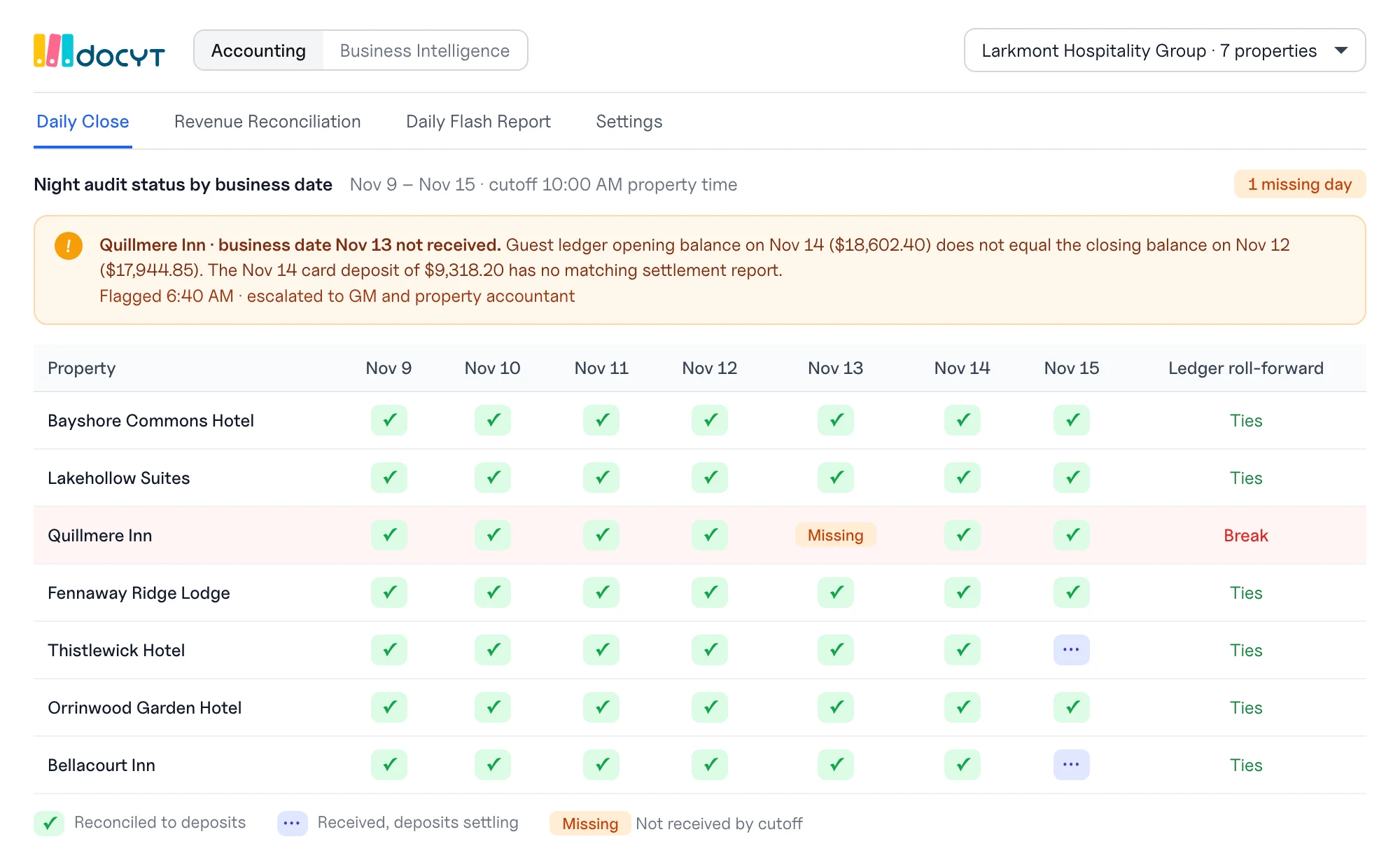
- Roll the guest ledger forward. Today’s opening balance should equal yesterday’s closing balance. A break signals a missing or rerun day.
- Track business dates, not send dates. A checklist by property and business date makes gaps obvious.
- Match deposits to settlement reports. A deposit with no matching settlement report usually means a missing pack.
- Set a cutoff and escalation path. If the pack is not in by a set time, such as 10 a.m., follow up the same day.
At month-end, confirm that the revenue days posted equal the days in the month. Our hotel month-end close checklist covers that review.
How Finance Teams Automate This
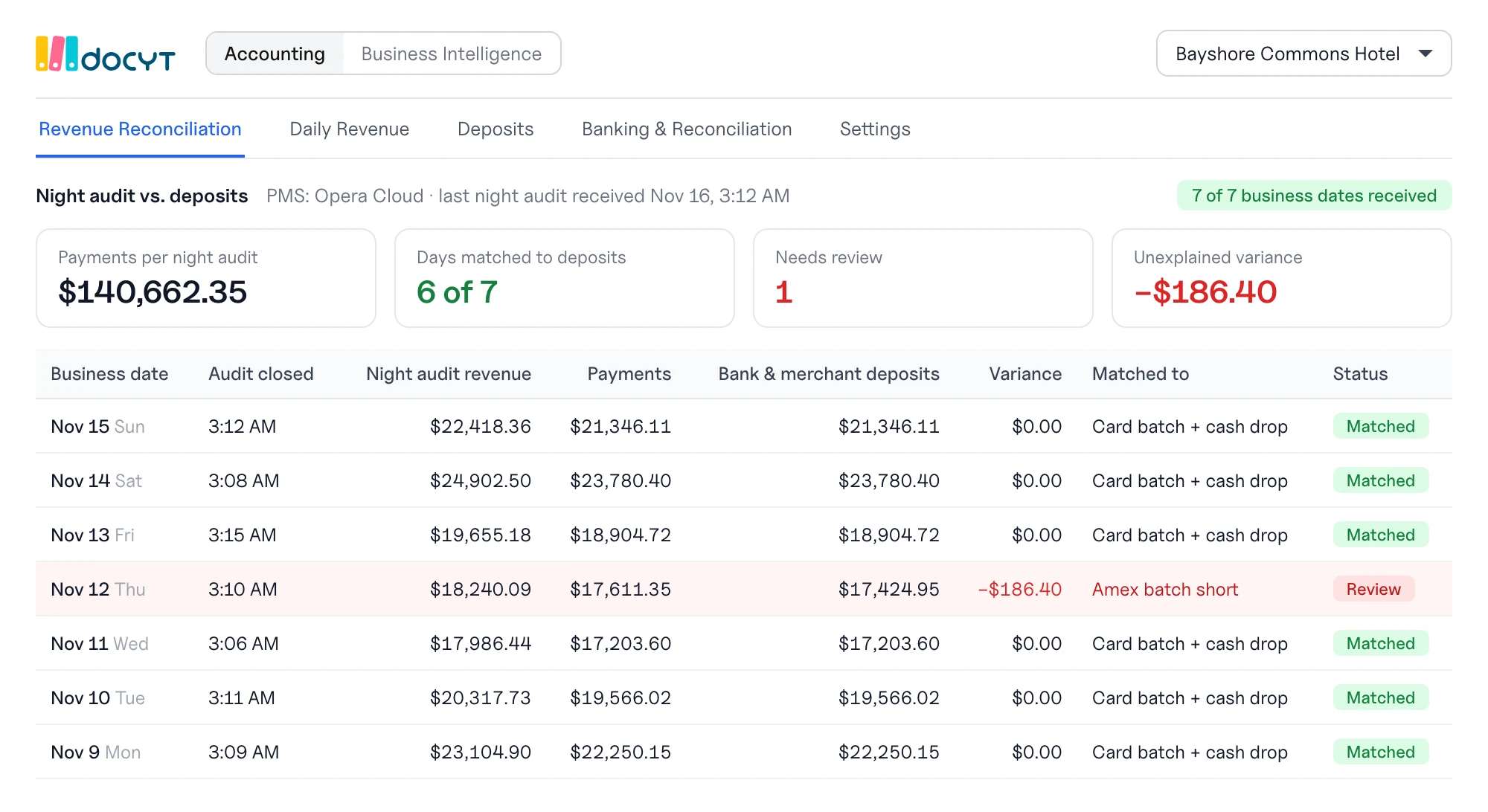
Manual packs depend on people remembering to send and check them. Docyt connects to PMS, POS, and merchant processor data, pulls in daily revenue as each property closes, and matches it to deposits. Our daily close view shows status by property, so a missing day is visible the same morning. See how daily revenue reconciliation works.
Summary Overview
- What to send: eight core reports for every business date, from the manager’s report to cash drops.
- Who gets it: the controller gets the full pack; the GM, AR, and owners get the reports tied to their decisions.
- How to catch a missing day: roll the guest ledger forward, track business dates, match deposits, and enforce a cutoff.
Talk With Docyt
Want every property’s night audit captured, reconciled, and visible each morning? Schedule a consultation with Docyt to learn more.