
It's the 5th of the month. A regional VP at a hotel management company asks what sounds like a simple question: how did the Courtyard in Tampa do on labor last month, by department, against budget? The controller can pull scheduled hours from the timekeeping system in a few minutes. But the real number, with payroll split by department, benefits and accruals booked, and allocations posted, won't exist until close. "Give us until the 15th," she says. By then, the VP has already approved next month's schedules.
That answer hasn't changed much in twenty years. What has changed is that almost every accounting vendor now claims to have AI. Yet the close still takes weeks, the reconciliation spreadsheets are still there, and the owner reports still go out late.
I've spent the last few years working with hotel operators, controllers and CFOs on this exact problem as CMO of Docyt. The pattern I keep seeing is simple. Most of the AI being sold to finance teams sits at the edges of the accounting process. The core, where the time actually goes, stays untouched.
Summary: why AI at the edges won't fix hotel accounting
- The problem: most AI sold to hotel finance teams suggests categories or answers questions, but does not own the ledger, the chart of accounts, the policy or the close.
- The alternative: an AI system with four layers (models, agents, workflows and CFO outcomes) running on one set of books, where the close is a state, not an event.
- Where it helps: daily revenue reconciliation, accounts payable, labor visibility, owner reporting, new-hotel onboarding and early warnings for the CFO.
- Your ERP: keep it and run the AI as a sub-ledger, or let the AI build the ledger.
- Trust test: every entry traceable, no ledger writes from general-purpose language models, no deleted corrections, segregated data and audited controls.
The problem: AI at the edges doesn't change the core
Walk into the accounting office of almost any multi-property hotel operator and you'll find the same scaffolding holding things together:
- Books that close days or weeks after month-end.
- A chart of accounts that was set up years ago and patched with every new property, brand standard or owner request.
- Bank rules, vendor mappings and reconciliation spreadsheets that only work because someone maintains them by hand.
- A close checklist that lives in one senior accountant's head. When she goes on vacation, the close slips.
Now layer AI on top. Legacy accounting vendors add "suggested categories." Standalone chat assistants can tell you your cash balance in a friendly sentence. Both are useful at the margin. Neither owns the ledger, the chart of accounts, the accounting policy or the close.
That is the gap. If the AI doesn't own the work, the work still lands on your team. Hospitality makes this worse than most industries. A single hotel produces daily revenue from a PMS, outlet sales from a POS, payroll by department, dozens of vendor invoices and owner reporting requirements, and a management company multiplies that by every property and every ownership entity.
What an AI finance system actually looks like
The shift I'd argue for is from AI features to an AI system: models, agents and workflows running together on one set of books. At Docyt we call this AI System One, but the framework is useful whichever vendor you evaluate. It has four layers.
1. Models that know accounting. Precision work such as coding transactions, matching documents, mapping PMS and POS revenue, reconciling and flagging anomalies needs models trained on accounting data, not the open internet. Docyt's HpAI (High Precision Accounting Intelligence) uses pretrained accounting models for this, trained on data from thousands of businesses across 15+ industries. Frontier language models handle the open-ended work: reading messy documents, explaining a variance in plain English, answering questions. The rule that matters: the language model must show its evidence and can never write to the ledger on its own. An orchestration layer routes each task to the right model and checks the output against accounting rules and confidence thresholds.
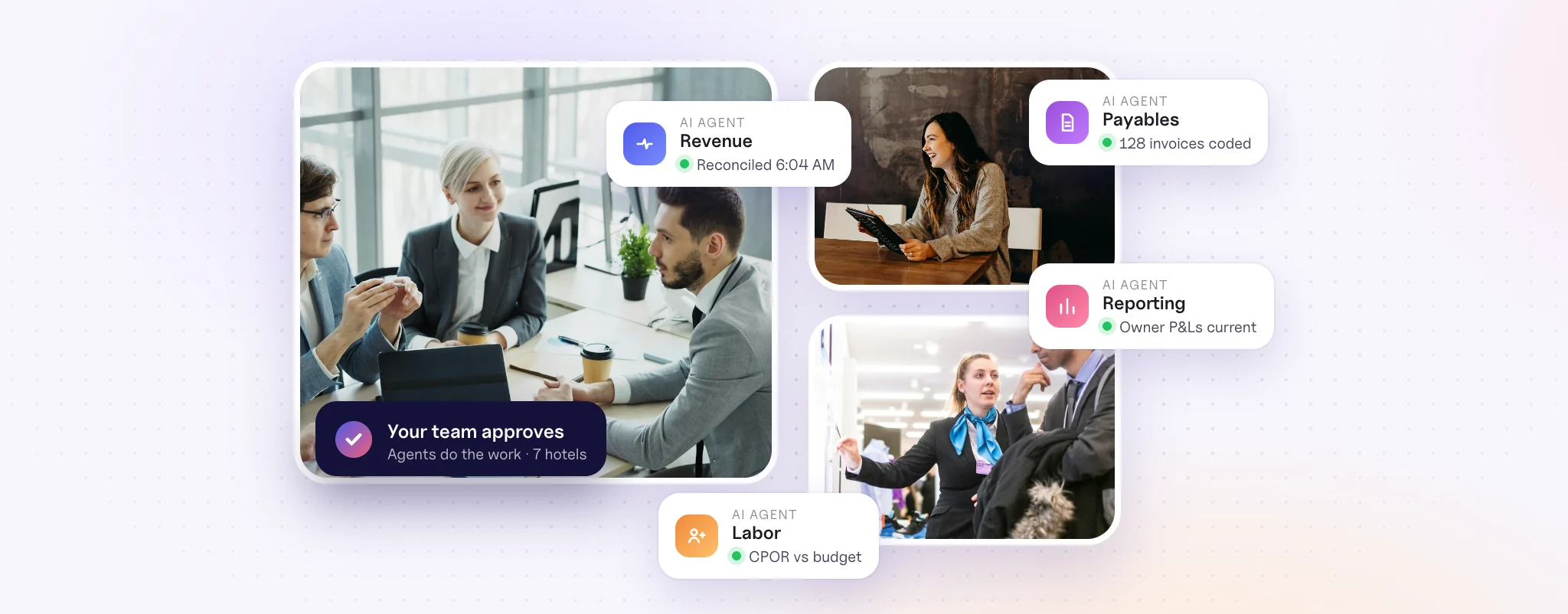
2. Agents that do the work. Agents run around the clock inside policies you define. They code, match, reconcile, close and post. They also handle migration from your old system.
3. Workflows that run end to end. Money out (AP and spend), money in (revenue and deposits), reconciliation, close and reporting run as connected processes rather than handoffs between tools and people.
4. CFO outcomes. Audit-ready books, a continuous close and reporting you can act on: reconciled revenue, controlled spend, a live flash report and P&L, budgets and forecasts, and owner reports.
Two ideas make this different in practice. First, the close becomes a state, not an event: transactions are coded and matched as they arrive, and reconciliations are prepared continuously. Second, every decision carries a confidence score, and each entity and period gets a close confidence level. Your team reviews the exceptions, with context, instead of re-checking everything.
Six hospitality use cases where this changes the day-to-day
Frameworks are easy to nod along to. Here is what this looks like inside a hotel management company. These scenarios are composites of situations I hear about from operators every week.
1. Daily revenue that reconciles itself
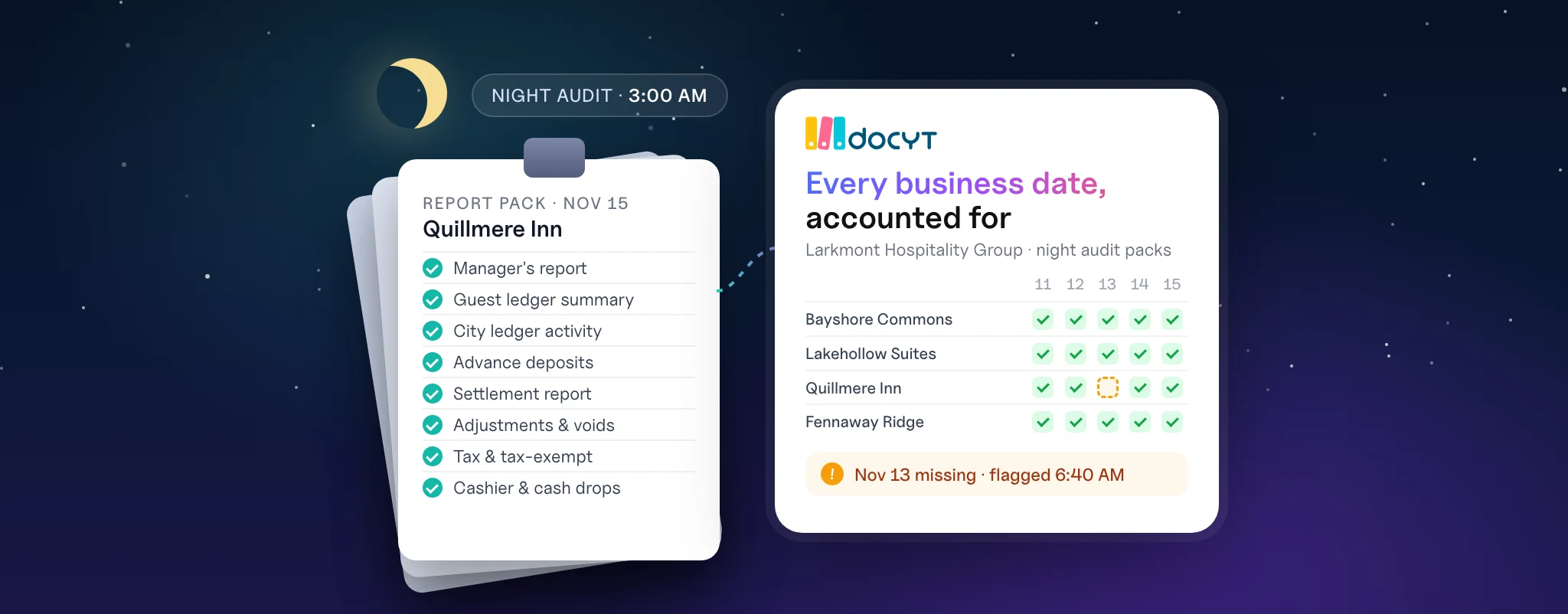
The situation. Every morning, the night audit closes in the PMS. Room revenue, occupancy tax, resort fees, F&B outlet sales from the POS, advance deposits and city ledger charges all need to land in the right GL accounts. Then credit card batches have to be matched to bank deposits that arrive two or three days later, net of processing fees. At most properties, an accountant does this by hand in a spreadsheet, and small gaps go unnoticed for weeks.
What changes. The system pulls the PMS and POS data daily, maps each revenue line to the right account, and matches card batches to deposits as they hit the bank. A missing deposit or a fee that doesn't match the processor's contract shows up as an exception the same week, not at month-end.
2. Accounts payable across 30 properties
The situation. A management company receives thousands of invoices a month: food and beverage distributors, linen services, maintenance contractors, utilities, brand and franchise fees. Each must be coded to the right property, the right department (rooms, F&B, A&G, maintenance) and the right USALI line. The same vendor often bills several hotels, sometimes twice for the same delivery.
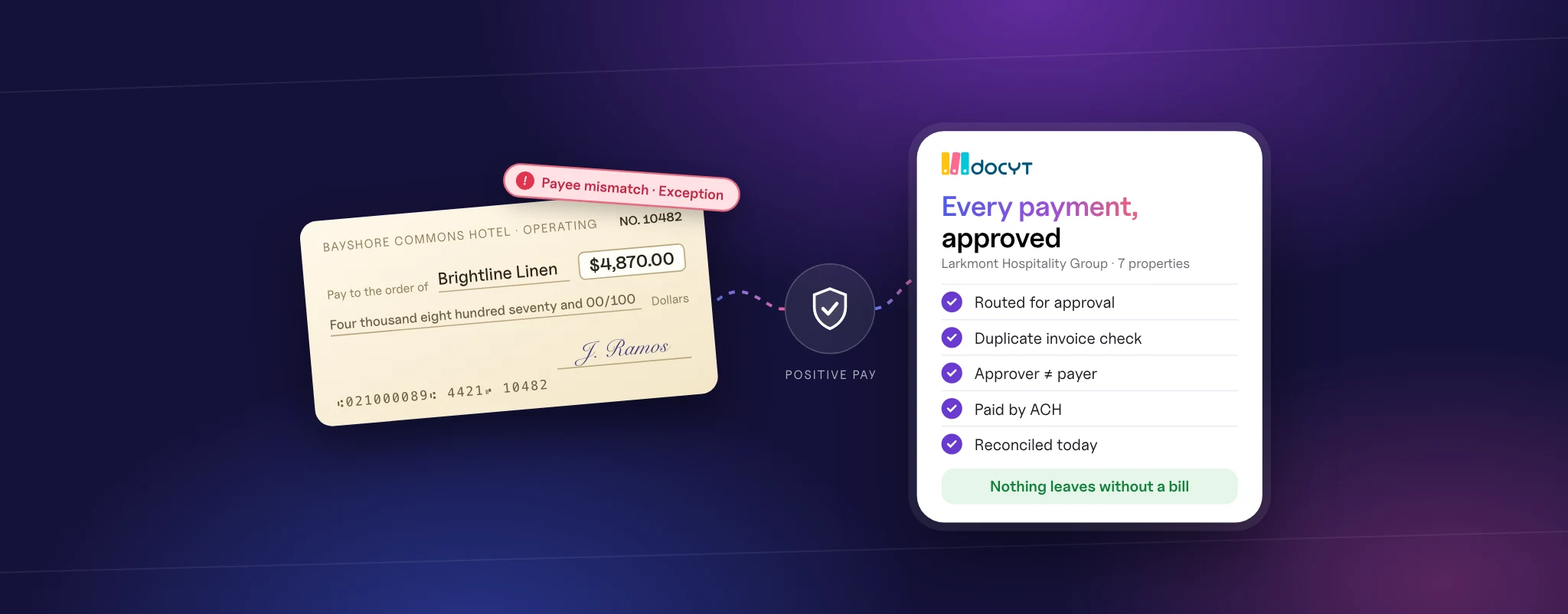
What changes. Invoices are read, coded and matched to the bank payment on arrival, using vendor history and the property's own patterns. A produce invoice coded to rooms supplies, or a duplicate invoice sent to two hotels, is flagged with its reasoning before it's paid. The AP team reviews low-confidence items instead of keying every line.
3. Labor visibility while it still matters
The situation. Labor is the largest controllable cost in a hotel. But payroll often lands in the GL as one lump, and the department split arrives after the close. By the time a GM sees that housekeeping labor per occupied room ran high, it's six weeks old.
What changes. Payroll is booked by department as it runs and tied to occupancy from the PMS. The regional VP's question from the opening of this article gets answered from a live flash report, while the schedule can still be adjusted.
4. Owner reporting across many ownership groups
The situation. A third-party operator might run 25 hotels for 12 different ownership groups. Each owner wants their own package, sometimes in their own format. Management fees, incentive fees, intercompany charges and shared-service allocations all need to be calculated and traced. Owner reports are often the last thing out the door, and the first thing owners judge you on.
What changes. Multi-entity books live in one ledger, with every entry traceable to its source document. Owner reports are produced from reconciled numbers, with plain-language variance explanations attached. When an owner asks why utilities were up 18%, the answer and the supporting invoices are one click away.
5. Onboarding a new hotel without a three-month project
The situation. A management company wins a contract to take over a hotel mid-year from another operator. The property arrives with its own chart of accounts, a different accounting system, open payables and a history nobody on your team knows. Converting it usually means months of mapping work, and the first few closes are messy.
What changes. Agents connect to the prior system and extract the chart of accounts, transaction history, vendors and open balances. They map it to your standard chart and reconcile the result. Faster onboarding means you can say yes to growth without adding headcount in accounting for every new property.
6. A CFO who sees problems before the owner does
The situation. A portfolio CFO reviews the month after it closes. Rate softness at one property, an OTA commission spike at another, a utility bill that doubled after a meter change. All of it is found late, usually in the owner meeting.
What changes. Anomaly detection watches every entity continuously. The CFO gets early alerts with context, real-time P&L and balance sheets across properties, and forecast drivers. A GM can also ask the system a question directly, such as "why is F&B cost of sales up this month?", and get an answer backed by the actual transactions.
You don't have to rip out your ERP
The first objection I hear from hotel CFOs is reasonable: "We just finished moving to NetSuite. We're not doing that again." You don't have to. There are two paths.
Keep your ERP. If you run QuickBooks, NetSuite, Sage or similar, the AI system works as a sub-ledger. It does the coding, matching and reconciliation, enhances your chart of accounts, and syncs clean, explained entries back to your ERP. Your system of record stays where it is.
Let the AI build the ledger. For operators on aging or fragmented systems, the AI system can generate an industry-specific chart of accounts and general ledger and become the system of record, with a multi-entity ledger, a document vault, and vendor, customer and employee masters in one place.
If you're not sure which fits, start with an assessment. Review your current stack, including the ERP, chart of accounts, bank rules, spreadsheets and point tools, and decide what to keep, what to run as a sub-ledger, and what to replace.
Trust: five questions to ask any AI accounting vendor
Controllers are right to be skeptical. An AI that posts entries nobody can explain is worse than no AI at all. Whoever you evaluate, ask these:
- Can I trace every entry? You should see the source document, the agent's decision and reasoning, its confidence, and the effect on the ledger, P&L, balance sheet and reconciliation.
- Who is allowed to write to the ledger? General-purpose language models should explain and assist, never post on their own.
- What happens to corrections? Nothing should be deleted. Corrections should be new entries with a full audit log.
- Does my data train models for other customers? It shouldn't. Your data should be segregated, encrypted and used to improve your own results.
- What controls are audited? Look for SOC 2 Type II, encryption in transit and at rest, SSO, role-based permissions and segregation of duties.
For transparency: Docyt reports 99% categorization accuracy, 99% reconciliation accuracy, more than $1.3B in invoice volume processed and 30+ POS and PMS integrations. Ask every vendor for their equivalent numbers, and ask how they measure them.
Where to start
Hospitality runs on thin margins and fast decisions. Finance teams that close in three weeks are reporting on a business that has already moved on. Adding a chatbot to that process won't fix it. Changing who owns the work will.
If you run finance for a hotel management company or ownership group, my suggestion is simple. Pick one property and one painful workflow, usually daily revenue reconciliation or AP. Measure how long it takes today and how many exceptions slip through. Then compare that against an AI system doing the same work for one close cycle.
If you'd like to see how this works on your own stack, I'm happy to connect you with the team at Docyt, or reach out to sales@docyt.com.
Frequently asked questions
What does "AI at the edges" mean in accounting?
It means AI features that sit around the accounting process, such as suggested categories or a chat assistant that reports your cash balance, without owning the ledger, the chart of accounts, the accounting policy or the close. The work that takes the time stays with your team.
What is an AI finance system for hotels?
It is models, agents and workflows running together on one set of books. Accounting-trained models code and match transactions, agents code, match, reconcile, close and post inside your policies, workflows run end to end, and the result is audit-ready books, a continuous close and live reporting.
Do hotel management companies have to replace their ERP to use AI accounting?
No. If you run QuickBooks, NetSuite, Sage or similar, the AI system can work as a sub-ledger that does the coding, matching and reconciliation and syncs clean, explained entries back to your ERP. Operators on aging or fragmented systems can instead let the AI build the ledger and become the system of record.
What should a controller ask an AI accounting vendor?
Ask whether every entry can be traced to its source document and reasoning, who is allowed to write to the ledger, how corrections are handled, whether your data trains models for other customers, and which controls are audited, such as SOC 2 Type II, encryption, SSO and role-based permissions.
Baglan Rhymes is Chief Marketing Officer at Docyt, an AI-powered accounting platform built for hospitality.