

A management company we hear from often runs one hotel it owns outright alongside roughly thirty hotels it manages for other owners. Each owner needs to see only their own property’s financials. The management company’s corporate team needs to see everything, across every property, in one place. And nobody wants to get there by keeping thirty separate sets of books, or by manually exporting and redacting a spreadsheet every time an owner asks for a report. This is the configuration framework for solving multi-owner hotel portfolio permissions using a single connected ledger, rather than duplicated financials.
Why Duplicate Books Become the Default Workaround
The instinct that leads most management companies toward duplicate books is reasonable on its face. If Owner A should never see Owner B’s numbers, the simplest way to guarantee that is to keep Owner A’s property in a completely separate accounting file from Owner B’s. Each owner gets a clean, isolated view. The problem shows up on the corporate side. Once there are thirty separate files, producing a single consolidated portfolio view for the management company’s own leadership means exporting data out of thirty places and rebuilding it into one, by hand, every reporting cycle. The isolation that protects each owner’s privacy is the same isolation that makes portfolio-wide visibility slow and error-prone.
The fix is not to compromise on separation. It is to separate access to one connected set of books, rather than separating the books themselves. Every property’s transactions live in a single, portfolio-wide ledger, and what any given user can see is determined by a permission layer sitting on top of it, not by which file they were given access to.
Entity-scoped roles
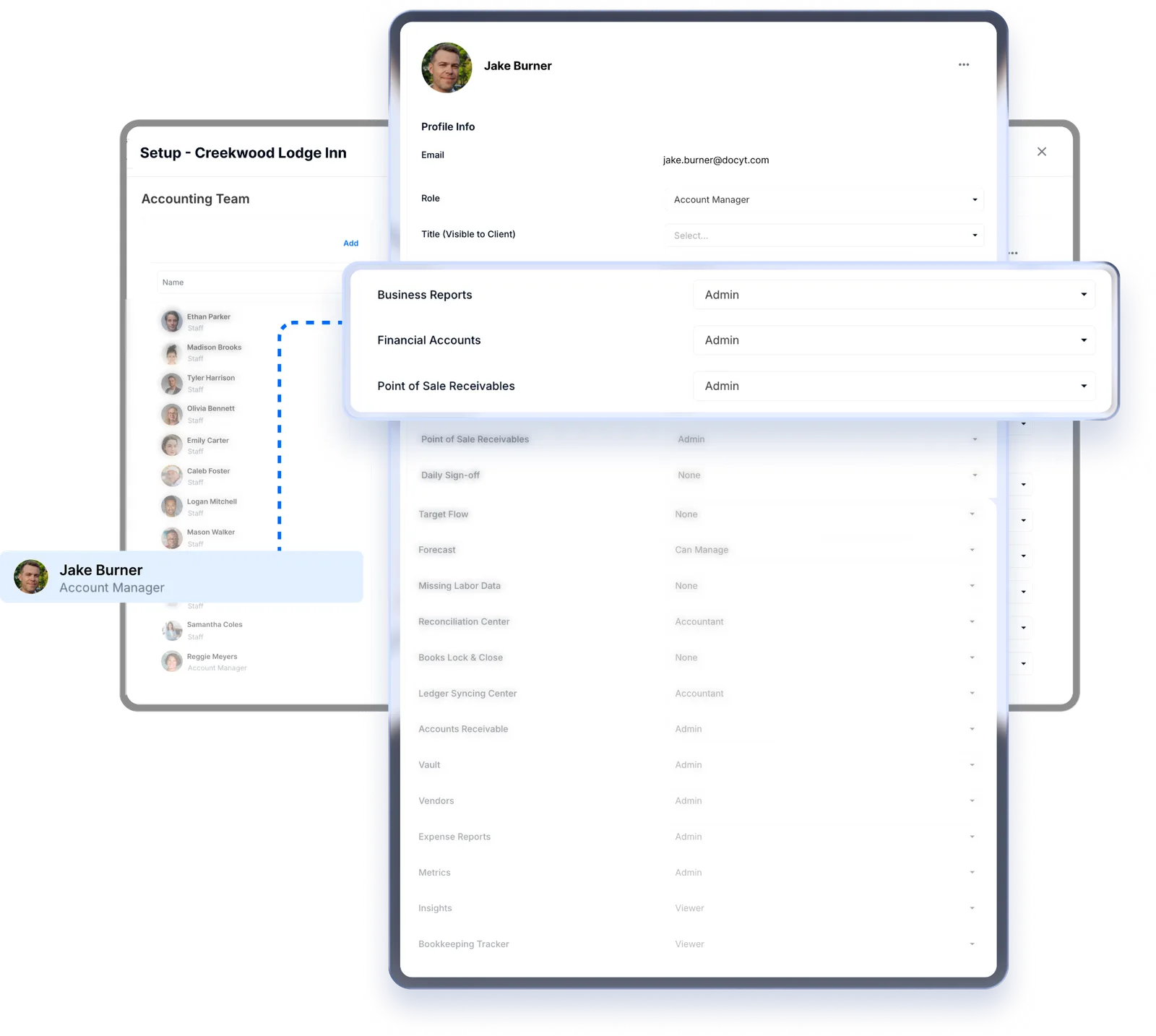
Every user in the system gets assigned to one or more entities, meaning specific properties, and their access is scoped to exactly those entities. An owner with one property sees that property’s transactions, statements, and reports, and nothing else. An owner with three properties in the portfolio sees those three, consolidated together if they want a combined view, but never sees a fourth property that belongs to a different owner.
Portfolio roll-up reporting for corporate
The management company’s own accounting and leadership team gets a role scoped to the entire portfolio, so the same underlying data that powers each owner’s individual report also powers a single consolidated view across all thirty properties, with no separate export or manual rebuild required. The roll-up and the individual owner views are two lenses on the same ledger, not two different sources of truth that have to be kept in sync.
Report-level permissioning, not just entity-level
Some users need narrower access than a full property view. A regional director might need visibility into operating performance across several properties without seeing the ownership-level detail (debt service, distributions) an owner sees. Permissioning at the report level, not only the entity level, lets a management company grant exactly the visibility a given role needs, rather than choosing between full access and no access.
Worked Example: One Owned Hotel, Thirty Managed Hotels
Back to the scenario at the top of this article. The management company’s own hotel sits in the same ledger as the thirty managed properties, but its corporate finance team is the only group with a role scoped to see it alongside everything else, since it is both an owned asset and a managed one from an operating standpoint. Each of the thirty external owners gets a login scoped only to their own property or properties. A regional operations director gets a role that includes operating statements for the properties in her region, but not the ownership-level distribution detail. Corporate leadership gets the full roll-up. All four of these views are generated from the same underlying transactions, updated at the same time, so no owner is ever looking at a number that has not been reconciled against what corporate sees for that same property.
Why This Matters More as a Portfolio Grows
At five properties, duplicating books is annoying but manageable. At thirty, it stops being a reporting inconvenience and becomes a real operational bottleneck, since every new managed property adds another file to maintain, another export process to remember, and another opportunity for an owner report to drift out of sync with what corporate’s own books show for that property. A permissioning model scales differently. Adding a thirty-first managed property means adding one more entity and assigning the new owner’s role to it, not standing up a new set of books from scratch.
What This Looks Like Day to Day
We built our portfolio roll-up reporting and multi-owner permissioning so a management company can onboard a new owned or managed property into the same connected ledger everyone else sits in, assign the right people to the right entities and report types, and never have to choose between owner-level privacy and corporate-level visibility. The result is a single source of truth that produces both views at once, rather than two separate processes that have to be reconciled against each other by hand.
As third-party hotel management has continued to grow as a share of the U.S. hotel industry, portfolios that mix owned and managed properties under one operating company have become increasingly common, which is exactly the structure this kind of permissioning is built to support.
Summary Recap:
- Multi-property management companies often default to duplicate books to keep each owner’s financials separate, which makes corporate-level portfolio visibility slow and manual.
- The alternative is permissioning one connected ledger rather than duplicating it: entity-scoped roles, portfolio roll-up reporting for corporate, and report-level permissioning for roles that need partial visibility.
- A single owned hotel alongside dozens of managed properties can all sit in one ledger, with each owner, regional director, and corporate leader seeing exactly the slice they should.
- This model scales far better than duplicate books as a portfolio grows, since adding a property means adding an entity and a role, not standing up a new set of books.
Ready to see this in your own portfolio?
Schedule time with our team to walk through how Docyt applies this to your properties. Schedule a consultation with Docyt