Ask a General Manager (GM) mid-month whether the hotel is going to hit its profit target, and in a lot of portfolios, you will get a shrug. Not because the GM doesn’t care – most care a great deal – but because the financial information to answer that question simply doesn’t exist yet. The monthly P&L hasn’t closed. The books are still catching up. And by the time the numbers are official, the month is over and there’s nothing left to do about them.
The GM is the person closest to the levers that move profitability: staffing levels, vendor spend, rate decisions, departmental cost control. But those levers only work when the GM knows where the numbers stand while there’s still time to pull them. That’s the quiet, expensive reality behind a lot of missed profit targets, not poor management, but poor timing. The information arrives after the decisions that could have changed the outcome.
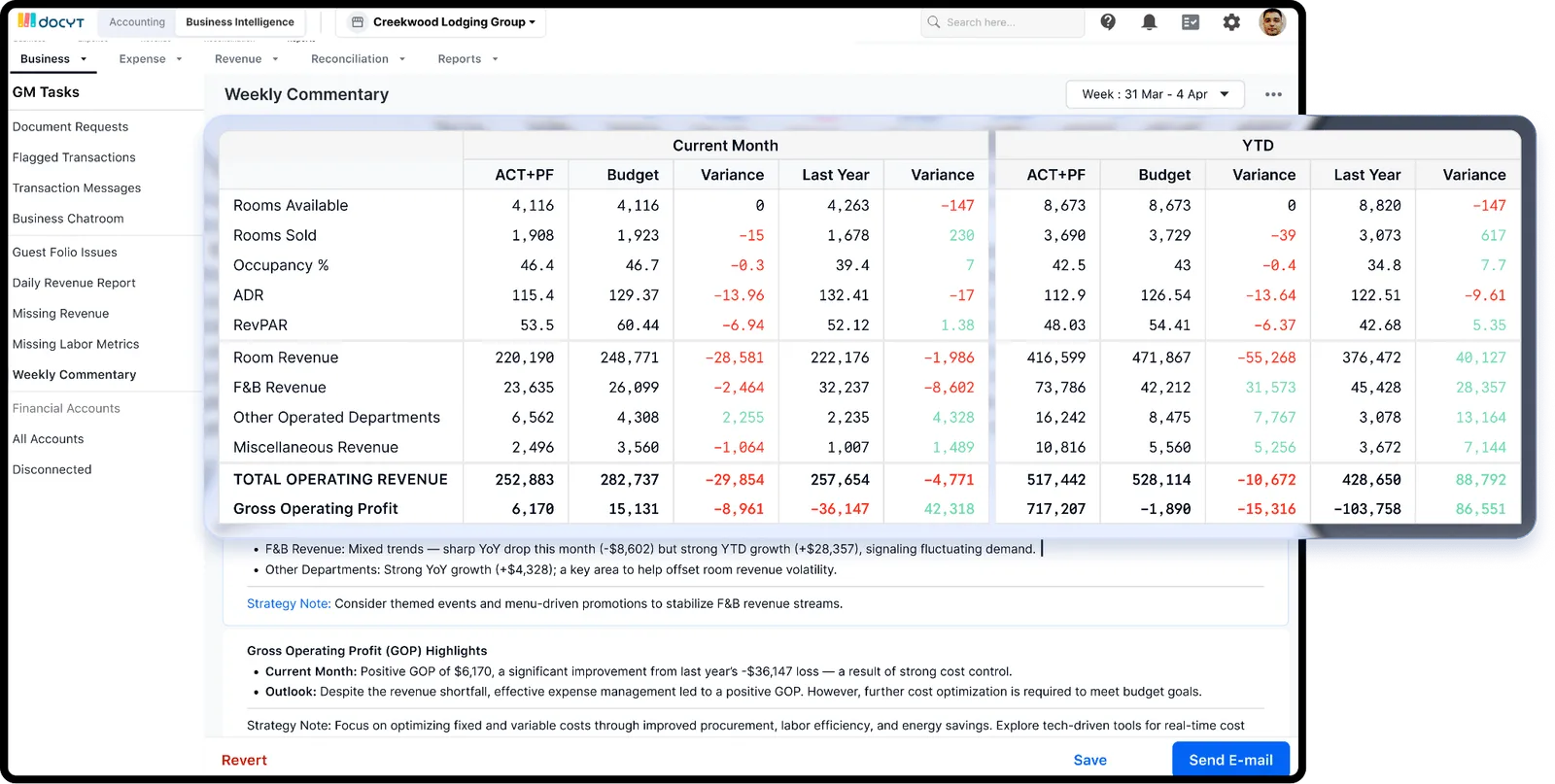
Docyt’s GM Weekly Commentary closes that gap. Every week, each property’s GM reviews a structured report inside the platform showing current-month performance against budget and prior year – across room revenue, F&B, other operated departments, and down to Gross Operating Profit. Beneath the numbers, Docyt’s AI generates written insights tied to the week’s variance: what drove it, what it means for the remainder of the month, and where to focus. The GM reviews, adjusts if needed, and sends it – turning a blank-box exercise into a consistent, accountable weekly rhythm. What makes it a profit management tool rather than a status update is the continuous accounting engine behind it: because Docyt’s AI Agents process every transaction in real time, the figures the GM reviews each week reflect the actual state of the books today, not an estimate assembled the night before.
The real cost of GMs not knowing where they stand mid-month
Think about what a GM can actually do to protect a profit target: adjust labor scheduling, push a rate change, tighten a discretionary expense, lean on the revenue team for an ADR push. Every one of those levers is time-sensitive. Pull them on day 10 of the month, and they can meaningfully change the outcome. Pull them on day 28, after the books have closed and the miss is already locked in, and they are irrelevant.
Most hotel accounting setups guarantee GMs will only ever have the second option. Books close monthly. Reports get generated after close. By the time a GM has a real, actuals-based answer to “am I on track,” the month is already over. They are not being held accountable to a target; they are being told, after the fact, whether they hit one they never had visibility into.
This timing problem is compounded by a staffing reality most portfolios are already living with. The hospitality industry is projected to face an 18 percent labor shortfall in 2026, according to a recent hospitality staffing forecast built on AHLA data, with the sharpest gaps in housekeeping, front desk, and maintenance roles. Leaner teams mean less slack to absorb a missed target discovered too late. GMs need every day of runway they can get.
What a “living” budget-vs-actual view requires
Fixing this is not a reporting problem; it is a bookkeeping problem. You cannot build a trustworthy, current budget-vs-actual view on top of books that only close once a month. The data simply is not there yet. A GM checking their numbers on March 12th needs March 1st through March 11th to already be accurately booked, categorized, and reconciled, not sitting in a pile of unprocessed invoices and unreconciled transactions waiting for the accounting team to catch up in three weeks.
That is only possible with AI-powered daily bookkeeping: transactions categorized and reconciled as they happen, every day, so that on any given day of the month there is a real, current actuals number to work with. Combine that with a projected forecast for the remaining days of the month, and a GM gets something genuinely useful: a full-month picture, updated daily, compared against budget, available well before the month is actually over.
Inside the Friday GM Weekly Workflow
This is the structure behind Docyt’s GM Weekly Workflow. Every Friday, each property’s GM sees a report combining actuals-to-date with a projected forecast for the rest of the month, set against the budgeted profit target. Green means on track. Red means a course correction is needed, and there is still time in the month to make it.
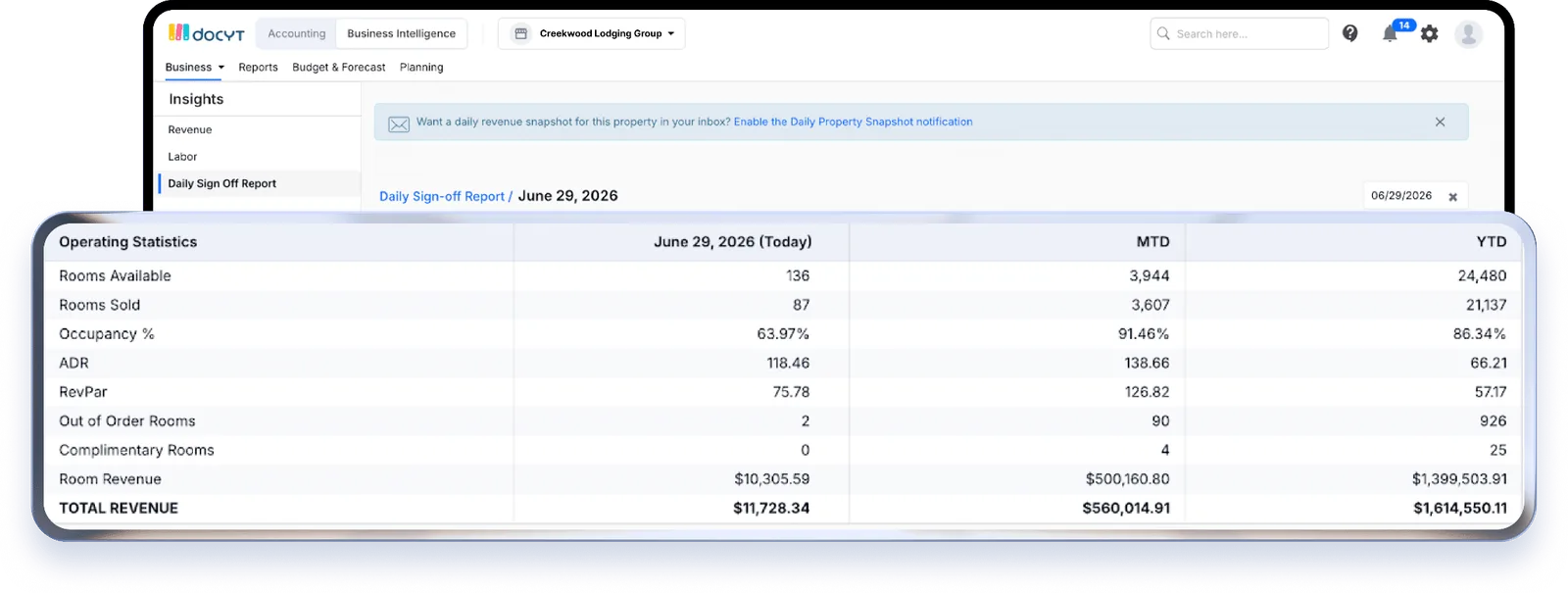
For an owner or asset manager overseeing a portfolio, the same report rolls up across every property. Instead of reviewing ten or twelve individual hotel reports line by line, a genuinely unmanageable task on a weekly cadence, ownership gets one consolidated view, every Friday, showing exactly which properties are tracking to budget and which need attention. It replaces a scattered, hotel-by-hotel check-in with a single, repeatable rhythm, part of the same real-time philosophy behind Docyt’s approach to profit target tracking more broadly across a portfolio.
From reactive to proactive: how mid-month visibility changes decisions
The value of this cadence is not the report itself; it is what a GM can do with two, three, or four weekly checkpoints across the month instead of one lagging report at the end. If week two shows the hotel trending behind on GOP, there is still time to look at the labor schedule, evaluate an ADR adjustment, or flag it to the revenue team before the gap widens. Each of those adjustments, caught early enough, is real GOP recovered rather than a variance explained after the fact. If the hotel is ahead of target, that is useful information too. Maybe there is room to invest in something that has been deferred.
This is the shift from managing a monthly scorecard to managing an ongoing target. GMs stop being evaluated after the fact and start actively steering toward the number throughout the month, which is a fundamentally different, and more effective, way to run a profit target.
Scaling GM accountability with AI-assisted commentary
One practical wrinkle with any weekly reporting cadence across a portfolio is consistency. Some GMs will write sharp, useful commentary explaining variance every week. Others will skip it, or write something too brief to be useful. Across a portfolio of ten or more properties, that inconsistency makes it hard for ownership to trust the commentary layer as much as the numbers.
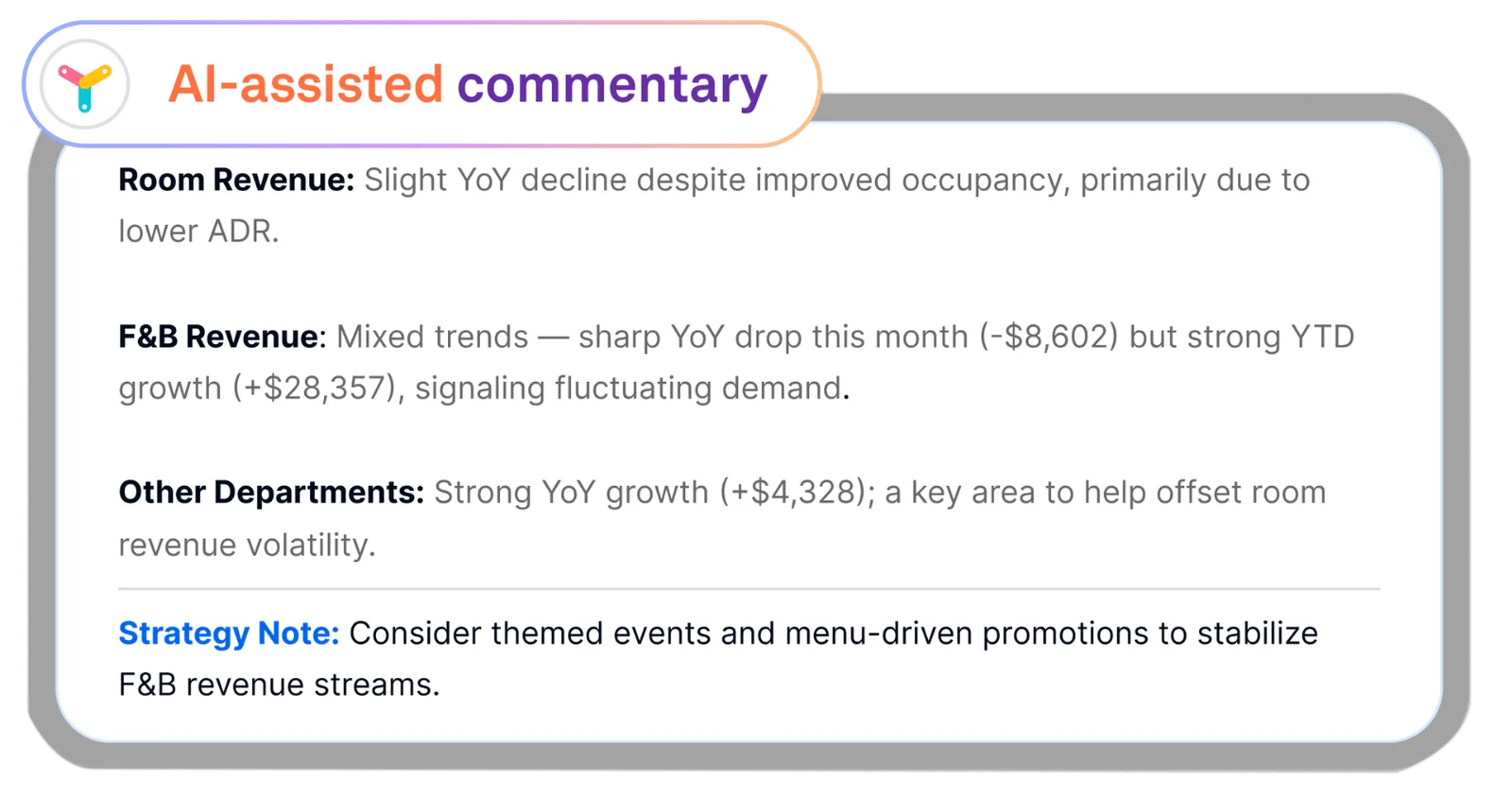
AI-assisted commentary closes that gap by analyzing the week’s variance and drafting a summary a GM can review, adjust, and finalize, rather than starting from a blank box every Friday. It keeps the qualitative layer of GM reporting as consistent as the quantitative one, which matters more the larger the portfolio gets. The same daily reporting foundation also feeds the kind of automated dashboards described in Hotel KPI Dashboard Tracks Automatically, so GMs and owners are always working from the same numbers.
Turn GMs into active profit owners
The underlying idea here is simple. A GM cannot be expected to hit a target they cannot see. Give them a current, weekly view of where they stand against budget, and you turn general managers from people who find out how the month went into people who actively manage how the month is going. You also turn ownership from auditors checking work after the fact into coaches with a real-time view of the whole portfolio.
See how Docyt’s GM Weekly Workflow works, and give every GM in your portfolio a weekly profit scorecard. Book a demo.