
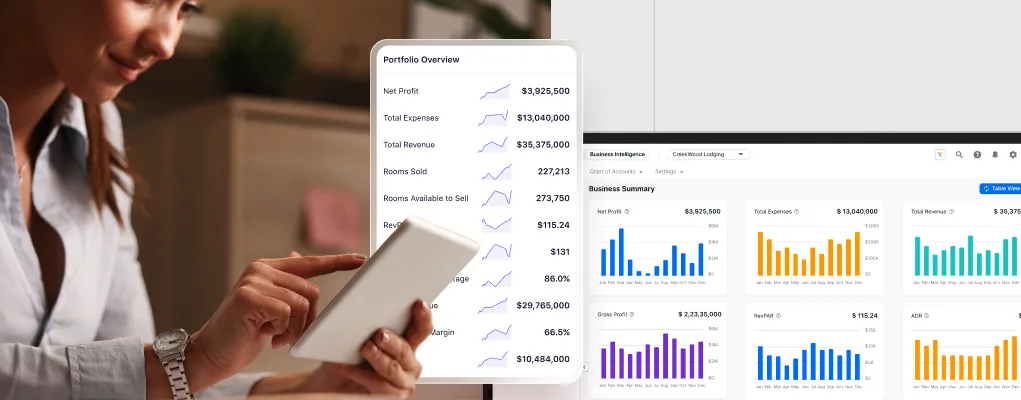
Ask most hotel owners how their property is performing right now, not last month, not last quarter, but today, and the honest answer is: they don’t fully know.
They might have a sense of occupancy. They might know roughly what last week’s revenue looked like. But whether the property is trending toward or away from its GOP target, whether labor is running over, whether F&B is recovering the margin it lost last quarter, that information lives somewhere in a spreadsheet that someone is still building, or in a report that won’t be ready until the 10th of next month.
This is the gap a hotel financial dashboard is supposed to close. But most operators either don’t have one, or have a version stitched together from manual data exports that’s already stale by the time it’s assembled.
For most hotel owners and management companies, the financial dashboard is one of three things: a weekly email summary assembled manually by the accounting team, a PMS-generated occupancy snapshot that doesn’t include costs, or a month-end P&L that’s outdated the moment it’s produced. The missing piece in all three is real-time profitability, and getting there starts with how the accounting is run.
The question isn’t whether a financial dashboard is valuable.
Every operator knows it is. The real question is what makes one possible, and why most hotel owners don’t have one that actually works.
The answer isn’t a dashboard problem. It’s an accounting problem.
Why Real-Time Dashboards Are an Accounting Problem First
A financial dashboard is only as current as the accounting that feeds it. And for most hotel operations, the accounting isn’t current.
The traditional hotel accounting cycle is periodic. Transactions accumulate throughout the month. The accounting team processes them in batches – coding invoices, reconciling bank statements, matching PMS revenue to the general ledger – and closes the books after month-end. The P&L lands in the owner’s inbox on the 10th or 15th of the following month. The financial dashboard, if it exists at all, reflects numbers that are already three to six weeks old.
This is why most hotel “dashboards” are actually just PMS snapshots. They show room revenue and occupancy because that data is available in real time from the property management system. But they don’t show costs. They don’t show labor against revenue. They don’t show whether GOP is on track. Because those numbers require accounting – and accounting, in the traditional model, doesn’t happen until the end of the month.
You can’t have a real-time financial dashboard without real-time accounting. The two are inseparable. The dashboard is the output. Continuous accounting is the engine.
This is the foundational insight behind Docyt’s AI-powered Accounting and Business Intelligence Platform. The platform doesn’t deliver business intelligence by adding a reporting layer on top of periodic accounting. It delivers business intelligence because the accounting never stops running.
Continuous Accounting: The Engine Behind the Dashboard
Docyt’s approach to accounting is continuous rather than periodic. Every transaction, every invoice, every bank feed entry, every PMS revenue post, every payroll run, is processed the moment it occurs. The books are never “closed” in the traditional sense because they never fall behind.
This is made possible by Docyt’s High Precision Accounting Intelligence (HpAI) architecture and AI Agents, which run autonomously across the full accounting workflow:
The Categorization Agent applies the correct account, department, and cost center to every incoming transaction with 99%+ accuracy. There is no end-of-month coding sprint because every transaction is categorized as it arrives. A food and beverage invoice from your produce supplier is mapped to the correct USALI account the moment it enters the system. A room revenue posting from the PMS is classified and applied to the general ledger the same day.
The Reconciliation Agent matches transactions across every connected data source – PMS, POS, bank feed, general ledger – with 100% accuracy. Discrepancies are flagged immediately. Revenue that posts in the PMS but doesn’t reconcile to the bank isn’t discovered weeks later during a manual close. It surfaces within hours.
The Quality of Books Agent continuously reviews the accuracy and completeness of the general ledger, delivering 5x faster book reviews than manual processes. Issues that would typically accumulate over a month and require correction at close are identified and resolved in real time.
The Month-End Closing Agent handles the structured close, journal entries, accruals, department-level finalization, across 20+ hotel verticals. Because the books are continuously maintained, month-end close drops from the industry-average 8–12 days to 1–3 days. The close becomes a confirmation, not a scramble.
The result of continuous accounting is a general ledger that reflects today’s reality, not last month’s. And a general ledger that reflects today is the foundation on which a real-time financial dashboard can be built.
The Data Pipeline: From Every System Into One Real-Time View
A hotel’s financial picture isn’t contained in one system. It’s distributed across at least six: the PMS for room revenue and occupancy, the POS for F&B and ancillary revenue, the payroll system for labor costs, the bank for cash movements, the procurement system for vendor spend, and the general ledger for classification and period allocation.
In a manually-managed operation, someone extracts data from each system, normalizes it into a common format, and assembles it into a report. This process takes hours or days, and the result is a point-in-time snapshot that’s already outdated.
According to Hospitality Technology’s 2024 Lodging Technology Study, the top challenge cited by 69% of US hotel respondents was the difficulty of integrating new technology with existing legacy systems - with data silos and operational inefficiencies as the direct consequences. This fragmentation is precisely why building a real-time financial dashboard manually is so difficult: the data is there, but no single system holds all of it.
Docyt eliminates this bottleneck through purpose-built integrations across the hotel technology stack:
PMS and POS integrations connect Docyt to 40+ property management and point-of-sale systems – including Opera Cloud, Choice Advantage, Fosse, SynXis, ONQ, Chorum, Clover, Square, Toast, and Lightspeed and more! Room revenue, F&B revenue, and ancillary revenue flow directly into the accounting engine the moment transactions post.
Payroll and time clocking integrations connect to 200+ systems, including ADP, Paychex, Gusto, Paylocity, Paycom, and Workday, pulling labor cost, hours worked, and department-level payroll data in real time. Labor as a percentage of revenue is calculated automatically, continuously.
Bank feed integrations connect to 25,000+ financial institutions, pulling daily transaction data that feeds both reconciliation and the general ledger without manual import.
Procurement and bill pay flow through Docyt’s AP automation, so vendor invoices are coded and posted to the ledger the moment they’re processed, not queued until someone manually enters them.
The data flow in Docyt’s platform looks like this:
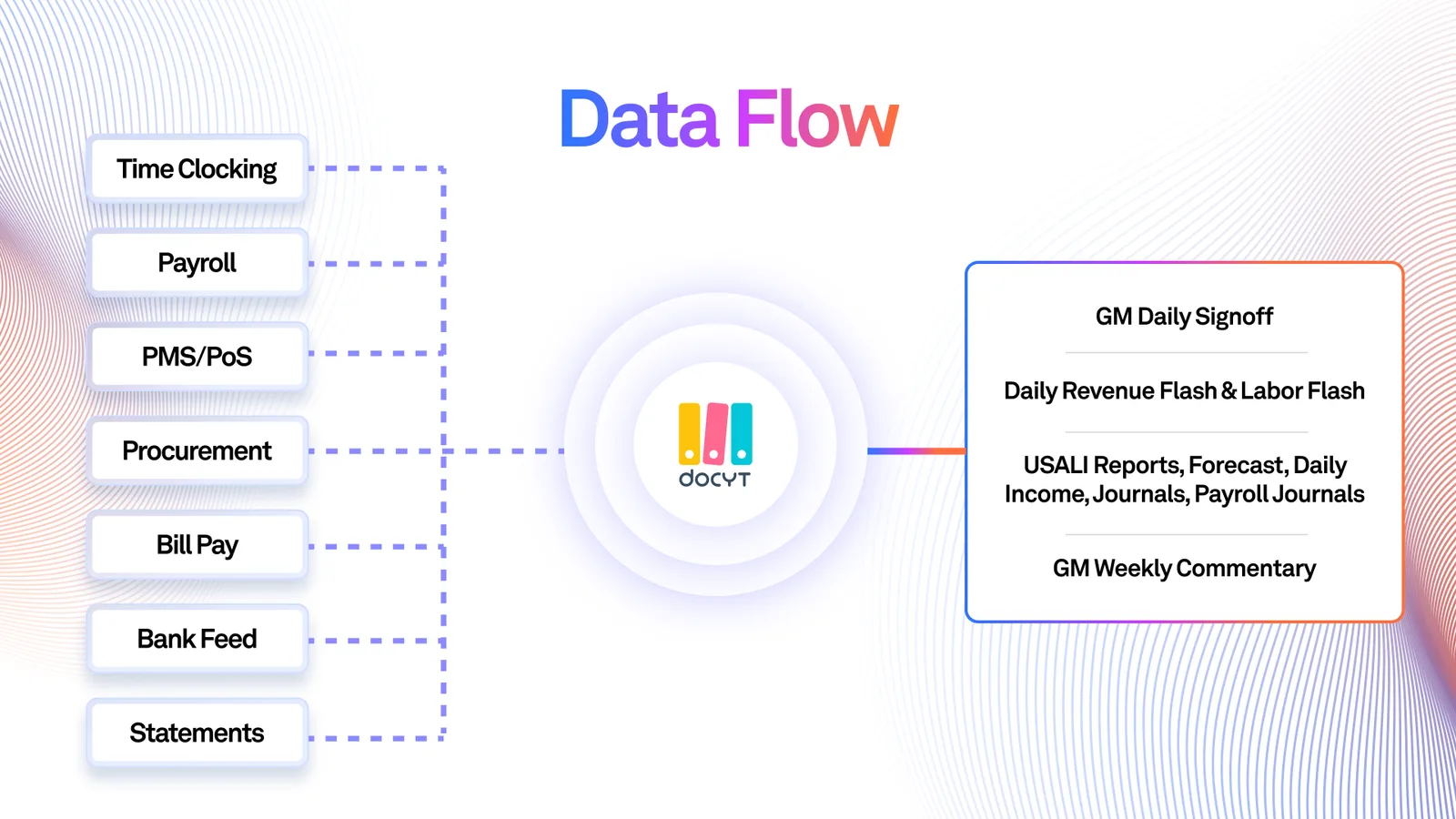
Every input is automated. Every output is current. The dashboard isn’t assembled manually, it’s the live output of an accounting system that never stops running.
How Docyt Delivers Real-Time Business Intelligence
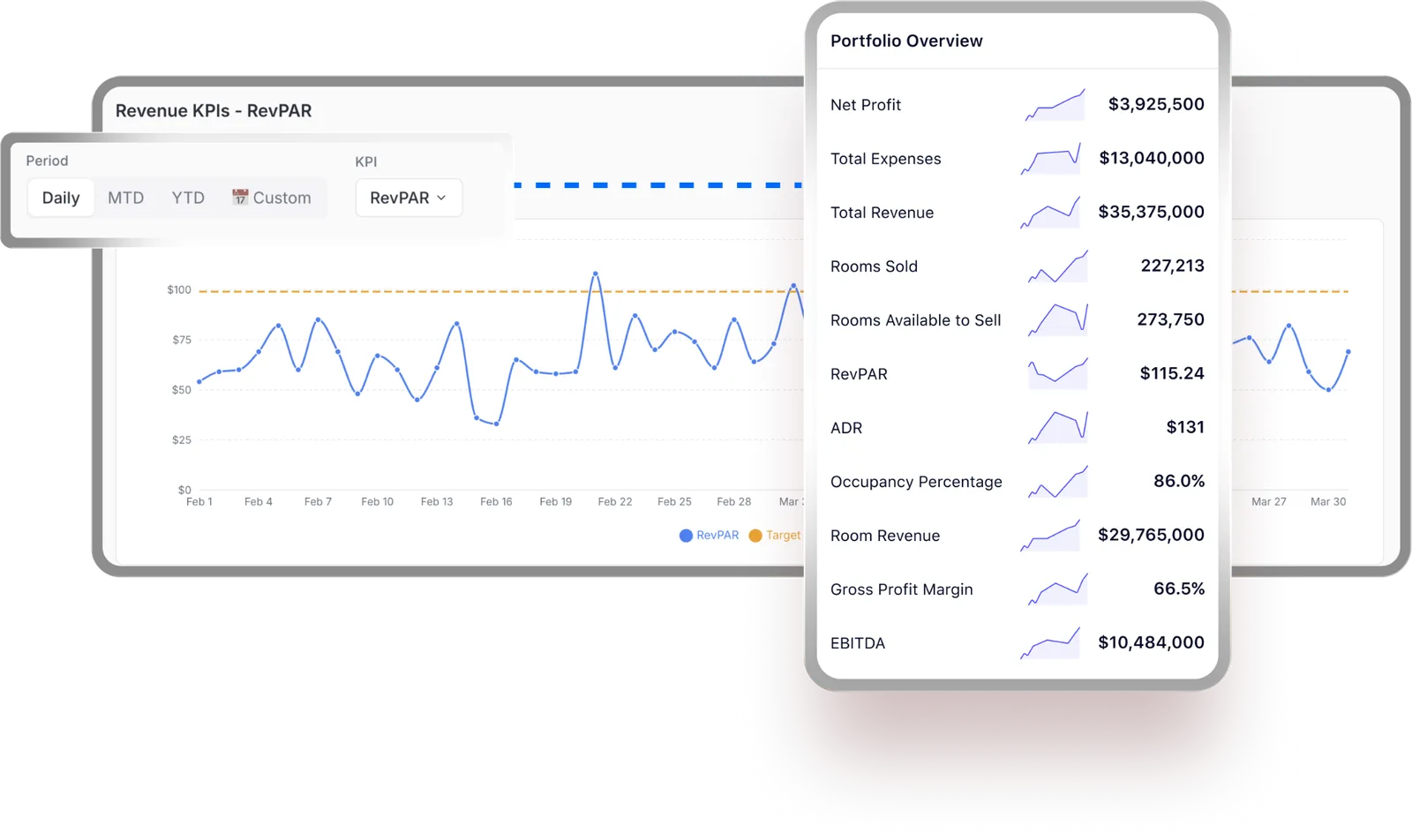
Because continuous accounting keeps the general ledger current, Docyt’s Business Intelligence layer can surface real-time financial visibility without any manual data preparation. Here’s specifically what hotel owners and operators see, and how it’s generated:
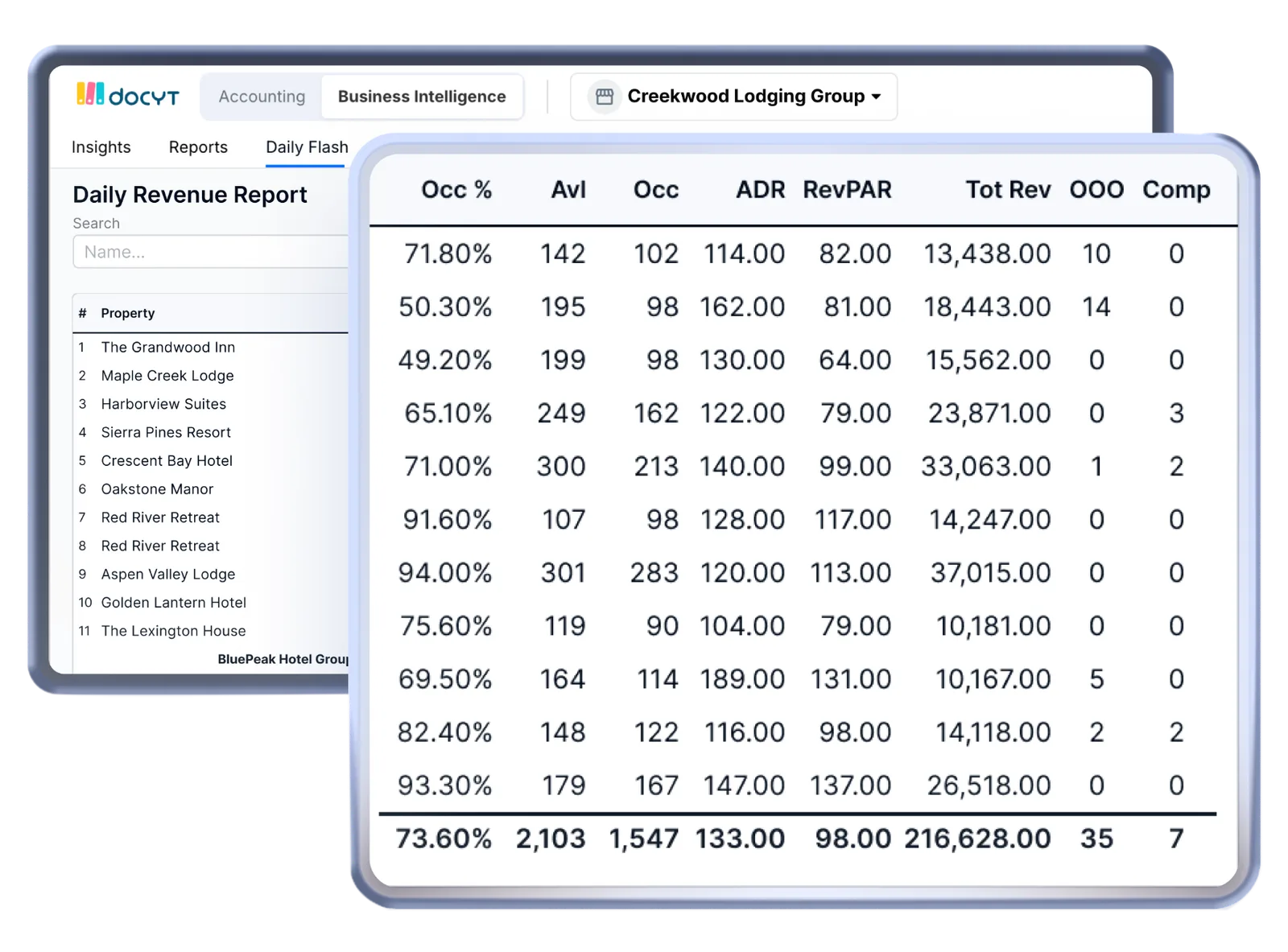
Daily Revenue Flash. Each morning, Docyt generates a Daily Revenue Flash that shows total revenue by department – Rooms, F&B, Other Operated Departments – against budget and against prior year same day. Because PMS and POS data flows directly into the continuous accounting engine overnight, the flash report is ready before the morning stand-up without anyone running an export or building a spreadsheet.
Daily Labor Flash. Alongside the revenue flash, Docyt generates a Daily Labor Flash that shows labor cost by department, hours worked, and labor as a percentage of revenue – pulled directly from connected payroll and time-clocking systems. For most hotel operators, labor is the single largest controllable expense and the hardest to track in real time. The Daily Labor Flash makes it visible every day, not just at month-end.
Real-Time P&L and GOP Tracking. Because Docyt’s Categorization Agent processes every transaction continuously, the P&L is always current. Gross Operating Profit is tracked month-to-date and year-to-date against the budget set at the start of the period. Hotel owners can see – on any given day – whether the property is on pace to hit its GOP target or whether a course correction is needed while there’s still time to make it.
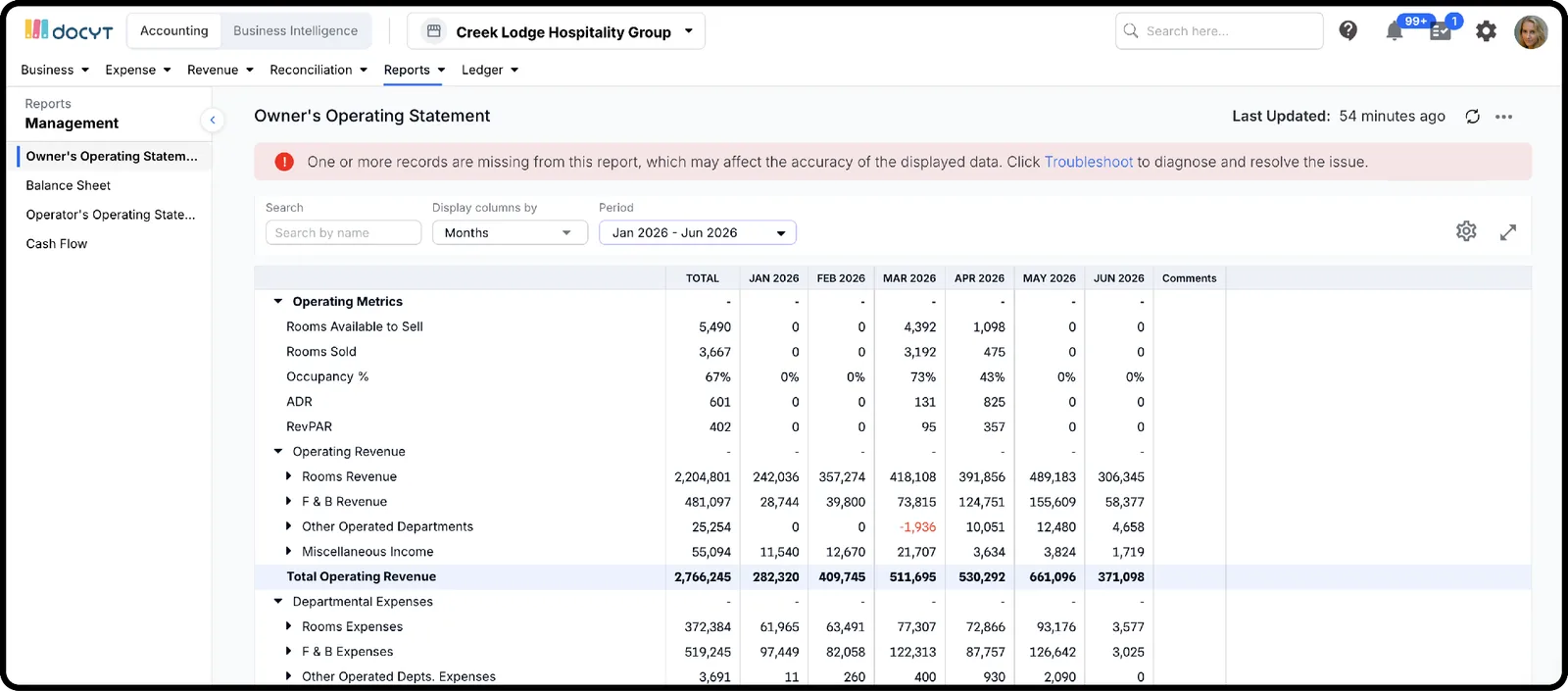
Owner/Operator USALI Reports. Docyt’s financial reports are structured to the Uniform System of Accounts for the Lodging Industry (USALI), the hospitality industry’s standard accounting framework. Every transaction is mapped to the correct USALI account by the AI Categorization Agent, so department-level performance (Rooms, F&B, Undistributed Expenses, GOP, NOP) is visible in real time in the format ownership groups, management companies, and investors actually use.
Variance & Flux Anomaly Detection. Docyt’s AI continuously monitors transaction patterns against historical baselines and budget expectations. When a spend pattern deviates materially – an F&B cost that’s running 30% above the prior week comparable, a vendor invoice that doesn’t match the contracted rate, a labor cost that’s spiking mid-week – the anomaly is flagged immediately. Operators deal with the issue when it can still be addressed, not when they discover it in the month-end P&L.
GM Daily Signoff and Weekly Commentary. Docyt closes the loop between financial data and operational accountability through two structured workflows. The GM Daily Signoff requires the General Manager to review and acknowledge the daily flash reports, confirming the numbers reflect actual operations or flagging discrepancies for the accounting team. The GM Weekly Commentary is a structured mid-period narrative in which the GM reviews budget vs. actual by department, explains material variances, and projects whether the property will hit its GOP target for the month. Together, these workflows turn data into accountability.
Portfolio Consolidations. For operators managing multiple properties, Docyt’s continuous accounting engine runs across every property simultaneously. Portfolio-level consolidation – daily revenue across all properties, labor across the portfolio, GOP by property – is available in real time without waiting for each property to submit reports. Inter-company reconciliation runs automatically. The portfolio view is always current.
Beyond real-time reporting, Docyt’s Business Intelligence (BI) pillar extends the dashboard forward with Revenue and Expense Forecasting, Daily and Monthly Budgeting, Target Flow Analysis, and On The Books Revenue Pickup. Together these tools project whether current performance will deliver the month’s GOP target – with enough lead time to act.
The dashboard doesn’t just show where you are. It shows where you’re going.
99%+
AI Categorization Accuracy100%
Reconciliation AccuracyReal-Time
Financial VisibilityWhat This Means for Multi-Property Operators
Single-property dashboard visibility is operationally valuable. For operators managing 5, 10, or 50 properties, portfolio-level real-time visibility is the difference between managing a business and reacting to one.
The challenge has always been standardization. If each property uses a different chart of accounts, or different coding conventions, or closes its books on a different timeline, building a consolidated portfolio view requires significant manual reconciliation – and by the time it’s done, it’s no longer current.
Docyt solves this at the infrastructure level. Standardized USALI charts of accounts apply across every property. Every transaction at every property is coded by the same Categorization Agent using the same rules. Inter-company reconciliation runs automatically. Portfolio Bill Pay consolidates AP across all entities.
The result is a management company or ownership group that can see – in a single real-time view – which properties are on track to hit their GOP target, which have labor running above budget, which have anomalies flagged for review, and what the portfolio’s consolidated profitability looks like today. Not next month. Today.
A Dashboard You Don’t Have to Build
The reason most hotel owners don’t have a real financial dashboard isn’t that they don’t want one. It’s that building one requires solving the accounting problem first, getting all the data sources connected, keeping the books current, and maintaining the accuracy needed to trust what the dashboard shows.
In a traditional accounting model, that’s a significant ongoing effort. In Docyt’s continuous accounting model, it’s automatic.
Every PMS feed, every payroll run, every bank transaction, every vendor invoice is processed in real time by AI Agents that categorize, reconcile, and flag with accuracy levels no manual process can match. The general ledger is always current. The USALI structure is always applied. The anomalies are always surfaced.
The Daily Revenue Flash, the Daily Labor Flash, the USALI reports, the GM Weekly Commentary, the portfolio consolidation – these aren’t reports someone produces. They’re the live output of an accounting engine that never stops.
You don’t build the dashboard. You open it. Because the accounting never stopped.
That’s the difference between a hotel financial dashboard built on periodic accounting and one built on continuous accounting. The first shows you where you were. The second shows you where you are – and whether where you’re going is where you need to be.
Docytis purpose-built for hotel owners and operators. See how continuous accounting and real-time business intelligence work together across your hotel portfolio bybooking a personalized demo today!