
There’s a number most hotel owners never calculate: the true cost of processing a single invoice.
Not the dollar amount on the invoice itself – the cost of handling it. Receiving it, logging it, coding it to the correct department and account, routing it for approval, verifying it against a purchase order or contract, scheduling the payment, issuing a check or ACH, and then reconciling it against the bank statement when the payment clears. Each of those steps requires a person, and each person-touch carries a cost in time that compounds across every invoice that comes through the door.
Hotels processing hundreds of invoices a month – food suppliers, linen services, maintenance vendors, OTA commissions, utilities, contract labor – are spending far more on the act of paying their bills than most owners ever stop to calculate. And in a margin environment where every cost line matters, that hidden overhead is one of the most actionable problems in the building.
The pressure is real. AHLA’s 2026 State of the Industry report found that rising operating expenses were the primary factor keeping hotel gross operating profit per available room (GOPPAR) at roughly 90% of 2019 levels – meaning the gap between revenue recovery and profit recovery is being driven almost entirely by cost creep. Back-office inefficiency is a direct contributor to that gap, and accounts payable is where a significant portion of it hides.
Accounts payable is one of the most overlooked profit leaks in hotel operations. And it’s almost entirely solvable.
How Hotel AP Actually Works Today – and Where It Breaks
Walk through a typical hotel invoice cycle, and the friction points become obvious.
A vendor submits an invoice. Depending on the property, it arrives by email, fax, postal mail, or gets dropped off at the front desk. Someone – usually in accounting, sometimes a department head – receives it, logs it into the system, and routes it for approval. The department manager who ordered the goods or service needs to verify the invoice matches what was actually received. The accounting team then codes it to the correct account and department, verifies it against any existing purchase orders, and schedules it for payment.
At each handoff, there’s a waiting period. Invoices sit in inboxes. Approvals get delayed because a manager is off property. Coding decisions get deferred because the right account isn’t obvious. By the time payment is issued, two to three weeks may have passed since the invoice arrived.
For a property with 200 vendors – a modest count for a full-service hotel – this isn’t a minor administrative burden. It’s a full-time function that grows in proportion to the complexity of the operation.
The downstream effects compound. Vendors who wait three weeks to get paid start building that uncertainty into their pricing. Early payment discounts – typically 1–2% for payment within 10 days – go uncaptured because the internal cycle is too slow to qualify. Finance teams spend their hours logging and routing rather than analyzing, which means the month-end close arrives with both a backlog of unprocessed invoices and an absence of the variance analysis that would make the numbers actionable.
And for multi-property operators, the problem scales. Each property running its own AP process means no portfolio-level visibility into vendor spend, no ability to consolidate payments, and no standardization of vendor terms or coding across the portfolio. The same vendor may be coded differently at three different properties. Cash management across entities becomes guesswork.
What Automated AP Actually Looks Like in a Hotel Context
Automating accounts payable in hospitality isn’t just about scanning invoices. It requires connecting AP to the operational and financial systems that give each invoice its context – the PMS, the chart of accounts, the vendor database, the purchase order system, the bank.
Docyt’s AP automation is built specifically for this complexity. The pipeline works like this:
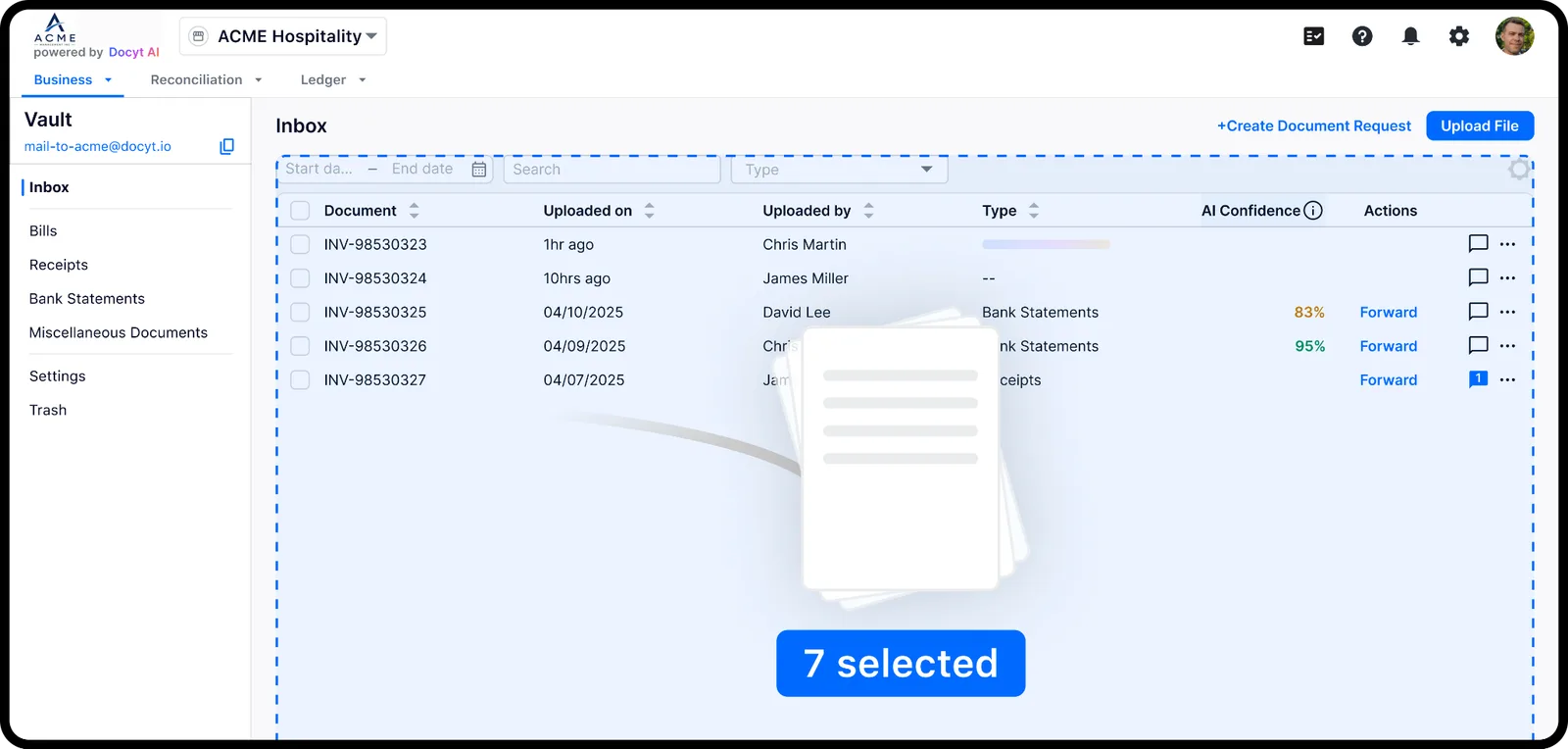
Document ingestion.
Invoices arrive through any channel – email, upload, vendor portal – and are automatically captured into Docyt’s AI Document Vault. There’s no manual logging. The invoice exists in the system the moment it’s received.
AI-powered coding.
Docyt’s Document Matching Agent (with a 95%+ match rate) identifies the vendor, matches the invoice against existing vendor profiles and historical coding patterns, and applies the correct account, department, and cost center automatically. An invoice from your linen supplier gets coded to the right housekeeping line without anyone touching it.
Exception surfacing.
Invoices that don’t match an existing vendor profile, exceed a threshold, or contain line items that don’t align with the purchase order get flagged automatically for human review. Your team reviews exceptions, not routine transactions. The Document Collection Agent handles follow-up on missing documentation at 85%+ faster response rates than manual processes.
Approval routing.
Flagged invoices and high-value transactions route to the right approver automatically based on department and dollar threshold. Approvals happen in the platform – no email chains, no lost approvals.
Payment execution.
Approved invoices are scheduled for payment via check or ACH through Docyt’s Portfolio Bill Pay system. Payment timing can be optimized to capture early-payment discounts or align with cash flow requirements.
Reconciliation.
Payments are automatically reconciled against the bank feed when they clear. The AP cycle closes without manual intervention.
The result is a process that handles routine invoices end-to-end without human involvement, surfaces exceptions immediately for focused review, and produces a clean, reconciled AP ledger continuously rather than at month-end.
The Multi-Property AP Problem – and Why It’s Different at Scale
Single-property hotel owners deal with AP friction. Multi-property operators deal with AP chaos.
When each property runs its own AP process, a management company or ownership group loses visibility into vendor spend across the portfolio. Payment terms negotiated at the portfolio level can’t be enforced if each property is making independent payment decisions. The same vendor may carry different payment terms, different coding, and different contact information across ten properties – all of which has to be reconciled manually when someone finally asks for a portfolio-level view of payables.
Docyt’s Portfolio Bill Pay consolidates AP across every property in the portfolio. All invoices flow through a single platform regardless of property. Vendor profiles are standardized across entities. Portfolio-level visibility into outstanding payables, approved invoices, and scheduled payments is available in real time.
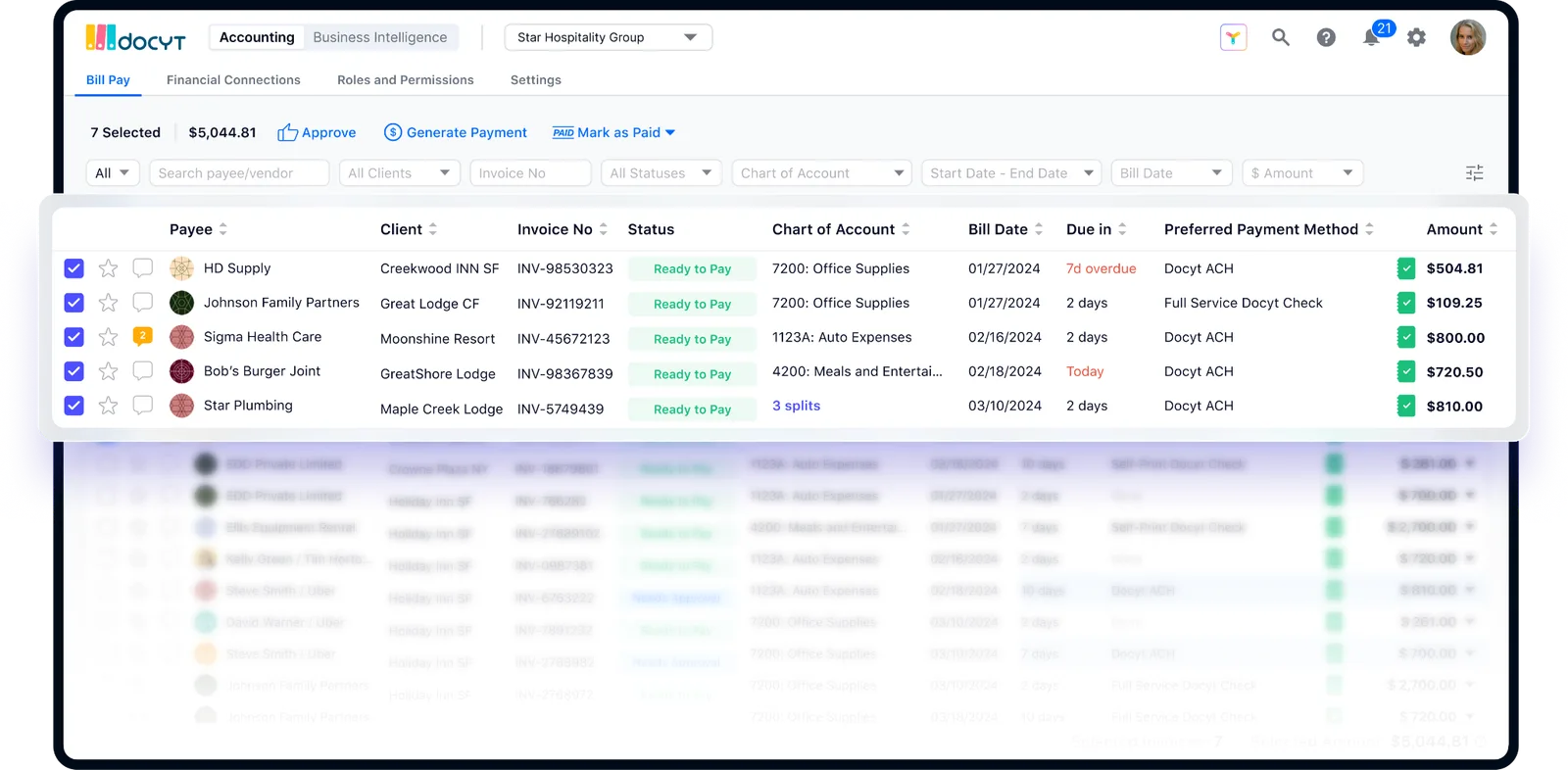
For a management company overseeing 10, 20, or 50 properties, this is the difference between AP as a decentralized administrative burden and AP as a managed, visible financial function – one that gives ownership a real-time picture of where cash is going and when.
What Your Finance Team Gets Back
The most underappreciated benefit of AP automation isn’t efficiency. It’s attention.
In a hotel finance team of two or three people, manual AP processing, receiving, logging, coding, chasing approvals, following up on missing documents, can consume the majority of working hours during peak invoice periods. That’s time that isn’t going toward variance analysis, spend trend review, department-level reporting, or the forward-looking financial work that actually helps ownership make better decisions.
The stakes of that misallocated attention are particularly high right now. AHLA’s March 2026 Front Desk Feedback surveyof 246 hoteliers found that operating costs are the single biggest challenge cited by hotel owners – and more than half of properties report being somewhat or severely understaffed. When finance teams are lean, the cost of spending skilled hours on transactional processing is doubly felt: the work that could be done with those hours doesn’t get done.
When AI handles the transactional layer, that time reallocates. The team that was processing invoices can be analyzing department-level spend trends, identifying vendors where pricing has drifted from contract rates, reviewing exceptions that actually require judgment, and supporting the month-end close with analysis rather than data entry.
This also matters for retention. AHLA’s 2026 State of the Industry projects the hotel industry will pay nearly $131 billion in wages and benefits in 2026 – a figure that keeps rising even as profitability lags pre-pandemic levels. In that environment, keeping skilled accounting professionals means giving them work worth doing. Accounting professionals who spend their days processing invoices don’t stay. Those who spend their days on meaningful financial work do. AP automation is as much a retention tool as it is an efficiency tool.
The Vendor Relationship Dimension
There’s a softer cost to slow AP that rarely shows up in analysis but is consistently felt by operators: what late payment does to vendor relationships.
Hotels depend on a supply chain that runs on trust. Your linen supplier who waits 30 days to get paid on net-15 terms doesn’t forget. Your food distributor who has absorbed three slow payment cycles doesn’t offer the best pricing on the next contract renewal. Vendors who regularly experience delayed payment have two rational responses: build a late-payment premium into their pricing, or deprioritize that account when supply is constrained.
Both of those responses cost the hotel real money – and both are avoidable. AHLA’s March 2026 survey found that supply costs are among the most frequently cited financial pressures for hotel owners, alongside labor and insurance. The hotels putting pressure on those supply costs through negotiation and consolidation are the same ones that vendors prefer to do business with – because they pay on time, every time.
When AP runs on a consistent, automated cycle, vendors know when to expect payment. That predictability changes the commercial relationship. You become the customer vendors compete for rather than accommodate. You qualify for early-pay discounts, better pricing on contract renewals, and priority service when supply is tight.
Docyt’s AP automation doesn’t just speed up payment. It makes payment predictable – which is what vendors actually need to price you fairly and treat you like a preferred customer.
From Cost Center to Controlled Function
Accounts payable doesn’t have to be a function you manage reactively, chasing invoices and reconciling exceptions at month-end. With AI-powered automation, it becomes a controlled, visible, and largely self-running part of your operation.
Every invoice gets captured the moment it arrives. Every routine transaction gets coded and routed without human intervention. Exceptions get surfaced immediately. Payments go out on time. The bank reconciles automatically. The month-end close doesn’t start with a backlog because the accounting has been running continuously all month.
In a cost environment where, as AHLA’s 2026 State of the Industry report makes clear, expenses are rising faster than revenue and profitability still lags 2019 levels, recovering margin from operational inefficiency isn’t optional – it’s where the work is. Accounts payable is one of the clearest opportunities in the building.
The finance team focuses on work that actually requires their expertise. Vendors get paid predictably and become better partners for it. And ownership gets a real-time view of where cash is going – instead of finding out six weeks after the fact.
Your AP process has been costing you more than the invoices. It doesn’t have to anymore.
Docyt is an AI-powered Accounting and Business Intelligence Platform, purpose-built for hotel owners and operators. See how automated accounts payable works across single properties and multi-property portfolios at www.docyt.com.