
Accounting has undergone a technological revolution over the last few decades.
Software replaced paper. The cloud replaced local servers. Automation reduced manual entry. Accounting today is more accurate, more efficient, and faster than at any point in history.
And yet, one burden remains unchanged: tax season.
Despite decades of innovation, tax preparation remains compressed, manual, and labor-heavy year after year.
But Why Tax Preparation Is Still So Labor-Intensive?
Tax season runs on deadlines that do not move. Returns converge at the same time regardless of how prepared clients are.
Meanwhile, client structures have become more complex. From multi-entity businesses and income spread across states to equity compensation and foreign reporting requirements, the work has grown more demanding.
Some clients remain organized; others reclassify transactions in December, mix personal expenses with business cards, or forward critical documents days before filing.
Compliance no longer stands alone. Projections, restructuring discussions, SALT positioning, and retirement timing requests now sit beside core filings.
All of it lands on teams already competing for experienced seniors in a tight hiring market. And each season expands in surface area while capacity remains fixed.
Why First-Generation Automation Didn’t Fix Tax Season
Accounting technology digitized binders, accelerated form preparation, and improved diagnostics.
Yet the underlying workflow changed very little. Information still arrives unevenly.
Cleanup still clusters in Q1. Data still moves across bookkeeping systems, portals, spreadsheets, and tax software before anyone signs a return. And the reviews still begins with confirming whether the numbers are dependable.
Most accounting software focuses on speed at the task level. But the stability across the workflow received less attention.
Rule-Based Automation Depends on Client Discipline:
Categorization rules perform well until clients override them. A new vendor appears. A payment channel changes. Expenses are reclassified late in the year. By December, someone is reviewing half the ledger. January becomes a correction month rather than a planning month.
Reconciliations Remain Periodic:
Monthly or quarterly reconciliations surface discrepancies in batches. Several weeks of transactions require explanation at once. Context grows thinner as the review window widens. Instead of evaluating elections or modelling entity strategy, staff retraces classifications and payroll allocations.
Systems Remain Fragmented:
Bookkeeping lives in one platform. Documents sit in another. Tax software operates elsewhere. Workflow tracking exists separately. Exports, re-uploads, cross-checks, and manual confirmations follow. Each system performs its function, yet the connections between them consume review time during peak filing months.
Automation Only Reduced Keystrokes:
Data entry became faster, but year-end rebuilding remained. Q1 still compresses backlog, corrections, and late-arriving information into the same narrow window.
Traditional automation improved efficiency within individual steps. It did not remove instability from the accounting layer. And instability is what makes tax season heavy.
The AI Shift: Continuous Intelligence inside the Workflow
The shift requires more than faster tools. It requires intelligence embedded directly inside the accounting workflow, operating continuously. And that is where AI accounting platforms like Docyt change the equation (a more detailed read: How AI is Changing the Game for Accountants)
Docyt strengthens the accounting foundation so judgment applies to positioning rather than reconstruction. Here is how that shift manifests inside a firm:
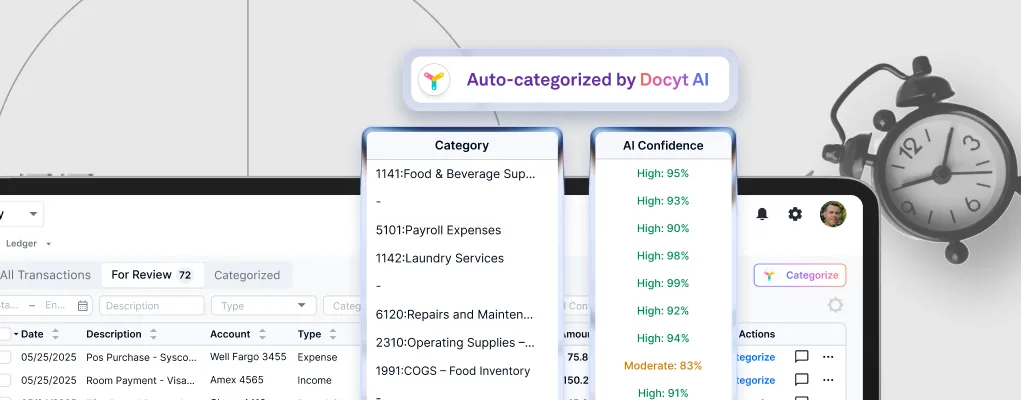
Continuous AI-Driven Transaction Coding: Brings Control Back to Classification Before Filing Season Begins
January pressure rarely starts in January. It starts in small choices made during the year, when transactions receive rough labels, and no one reviews them again until December demands attention. Daily AI coding under firm control breaks that pattern early.
Errors surface while the details are still fresh. Questions get answered close to the event itself. By the time filing season arrives, the books reflect steady oversight instead of last-minute fixes.
You notice the shift quickly. Teams enter Q1 with clarity on tax treatment and entity plans, because the records already match real activity. The benefit shows up in tax season, even though the discipline runs every day.
Real-Time Reconciliation: Eliminates the Q1 Rebuild of Bank and Credit Card Accounts
Ask any senior where long nights begin, and the answer often points to open balances. Continuous reconciliation addresses gaps when they appear, while the facts are still easy to confirm.
Weeks of past clean-up no longer flood the filing window. Trial balances are already aligned for review, which changes the tone of partner meetings. Elections, state exposure, and risk calls receive focus because basic balance checks already happened.
Accuracy becomes part of the system itself. Deadline stress loosens its grip.
Integrated Source Documentation: Turns Substantiation into a Built-In Process
Support gaps usually show up at the worst moment. When receipts and bills attach at capture, each entry carries its own proof from day one.
During review, credits and deductions are next to their supporting documentation, which shortens partner sign-off time and strengthens defense. Email chains requesting missing invoices shrink because retrieval occurs within the system.
Substantiation becomes a daily practice. Filing season no longer triggers a document chase.
Standardized Multi-Entity Architecture: Contains Complexity across Client Structures
Multi-entity clients increase review time when structures differ across companies. One unit follows one chart, another uses a variation, and group review then requires extra interpretation before analysis begins.
Standard charts align ledgers across entities so group reporting runs inside the same system that records activity. Automated rollups replace manual sheets, and intercompany balances settle within that shared setup.
Senior reviewers spend more time on tax plans across the group. Structural order prevents added review work as clients grow.
Continuous Close Model: Reallocates Effort across the Entire Year
Filing season strain often reflects uneven effort earlier in the year. A continuous close model keeps entries, reconciliations, and support current, which reduces backlog before January.
Work spreads across twelve months, making staff planning steadier and reducing sudden surges. Extensions follow the client strategy rather than the team limits. Partner review gains space for forward planning and sound judgment.
Tax season still demands skill. It no longer feels like a catch-up cycle.
Beyond Efficiency: What Stability Changes for the Firm
When the accounting layer remains current, the impact extends beyond processing speed.
Client expectations become manageable because projections and restructuring conversations can begin without the need for clean-up. Advisory discussions occur mid-year rather than after returns are filed.
Headcount pressure eases. Juniors focus on understanding transactions instead of correcting prior months. Seniors spend review hours evaluating elections, nexus exposure, and entity positioning.
Growth becomes rational. Adding clients does not automatically increase seasonal strain, because labor is distributed throughout the year. Margins strengthen as reconstruction hours decline and advisory bandwidth increases.
Suggested Reading: Accounting Firms Are Expanding Capacity Without Hiring. Here’s How AI Accounting Is Making It Happen
Docyt AI: A Complete, End-to-End Accounting Infrastructure for Accounting Firms
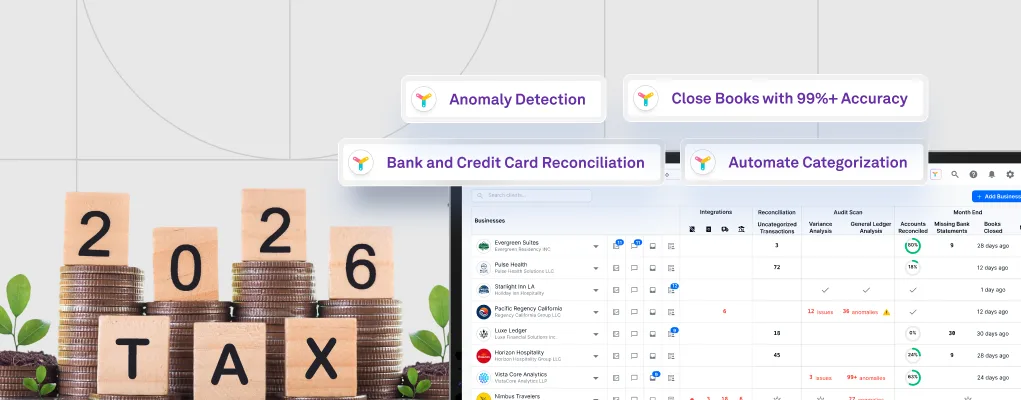
Docyt functions as a complete end-to-end accounting platform built specifically for accounting firms. Transaction capture, AI-driven coding, continuous reconciliation, integrated documentation, multi-entity architecture, and ongoing close management operate within one unified environment.
When:
- Transactions are structured daily
- Accounts reconcile continuously
- Documentation attached at the source
- Entities consolidate within the system
- Financials remain current year-round
Tax preparation stops being a rebuilding exercise.
As reconstruction declines, firm-level pressure eases. Rising client expectations become sustainable, advisory expands without proportional headcount growth, and seasonal compression reduces.
Tax preparation will always require expertise. Deadlines remain fixed. Complexity remains part of the profession. Reconstruction, however, is optional.
For mid-size accounting firms that feel the weight of every filing season, the question is practical: Is your current stack stabilizing the accounting layer, or accelerating isolated tasks within an unstable workflow?
Docyt is designed as a plug-and-play infrastructure that replaces patchwork systems with continuous intelligence. If you want to see what that looks like in a real-time environment, scheduling a focused demonstration can help you see how Docyt helps you run tax season on your terms.